Housing Needs Assessment and Action Plan

Share Housing Needs Assessment and Action Plan on Facebook Share Housing Needs Assessment and Action Plan on Twitter Share Housing Needs Assessment and Action Plan on Linkedin Email Housing Needs Assessment and Action Plan link

Housing Needs Assessment & Local Housing Action Plans

The City of Grand Junction and Mesa County are partnering on a combined Housing Needs Assessment (HNA) to better understand housing conditions, trends, and needs across the region. By working together, the City and County can leverage shared data, regional market insights, and community input to create a more complete picture of local housing challenges and opportunities.

While the Housing Needs Assessment will be completed jointly, the City of Grand Junction and Mesa County will each develop their own separate Housing Action Plans. These plans will reflect the unique roles, responsibilities, and priorities of each jurisdiction, while remaining grounded in the same regional data and community feedback. The Housing Action Plan (HAP) will help identify actionable strategies to improve housing affordability, availability, and stability across the community.

This work will also help inform the City’s 2026–2030 Community Development Block Grant (CDBG) 5-Year Consolidated Plan, ensuring alignment with local, state, and federal requirements. Learn more about the CDBG 5-Year Consolidated Plan.

Community participation is a cornerstone of this effort. Input from residents, stakeholders, service providers, and community partners will directly inform the findings of the Housing Needs Assessment and shape the strategies included in the Housing Action Plan.

How the Community Can Participate

The community engagement process is designed to be inclusive, accessible, and transparent, with multiple ways to participate over several months. Engagement activities include:

Community Kickoff Open House

A public, drop-in open house will launch the process, providing an opportunity to learn about the Housing Needs Assessment, share experiences, and offer feedback on housing priorities and potential solutions. Interactive activities will allow participants to identify housing challenges, discuss tradeoffs, and highlight community needs and assets.

Community Kickoff Open House
๐Ÿ“… February 12, 2026
๐Ÿ•” 5–7 p.m.
๐Ÿ“ Mesa County Library

RSVP (optional)


Community-Wide Housing Survey

A comprehensive housing survey will be available online for multiple months to ensure broad participation. The survey will be offered in English and Spanish and will gather information on housing conditions, affordability, displacement risk, access to services, commuting patterns, and community belonging. Survey responses will be used alongside local and regional data to inform the Housing Needs Assessment.

Take the Community-Wide Housing Survey online.


Resident Focus Groups

As required by State Statute and HUD, to ensure voices that are often underrepresented in planning processes are heard, small, in-person focus groups will be held with specific populations.

Focus groups will include:

  • Spanish-speaking residents

  • Mobile home park residents

Residents with disabilities and those who may require accessible housing or services

If you are a resident who identifies in one of these key areas and would like to participate, please email housing@gjcity.org for more information.


Stakeholder Focus Groups and Interviews

Additional focus groups and interviews will be conducted with housing and community development stakeholders, including:

  • Affordable housing providers and service organizations

  • Developers, builders, lenders, and real estate professionals

  • Public officials and industry leaders

These conversations will help identify barriers, opportunities, and practical strategies to address housing needs at both the local and regional level. Information will be sent out directly to key identified stakeholder groups. If you are a member of one of these groups and would like to participate, please email housing@gjcity.org.


Public Meetings and Presentations

Draft and final results of the Housing Needs Assessment and Housing Action Plan will be presented at public meetings with Grand Junction City Council and the Mesa County Board of Commissioners, as required by state law and federal regulations. Dates TBD


Community Engagement Approach

Community input is central to this effort. The engagement process is designed to be inclusive, accessible, and transparent, and will ensure that residents, stakeholders, service providers, and community partners across both the city and county have meaningful opportunities to participate.

Feedback gathered through this process will:

  • Inform the regional Housing Needs Assessment

  • Shape jurisdiction-specific Housing Action Plans for the City and the County

  • Help guide future housing investments, policies, and funding decisions

The engagement strategy is intentionally flexible and will be refined throughout the process in coordination with City and County staff to respond to community participation and emerging needs.


What This Means for the Community

  • One shared assessment: Residents will contribute to a single, regionally informed Housing Needs Assessment.

  • Local action: The City of Grand Junction and Mesa County will each adopt their own Housing Action Plans based on their respective governance structures, resources, and policy tools.

  • Stronger outcomes: A regional understanding of housing needs paired with locally focused action plans supports more effective, coordinated solutions.


Timeline Snapshot

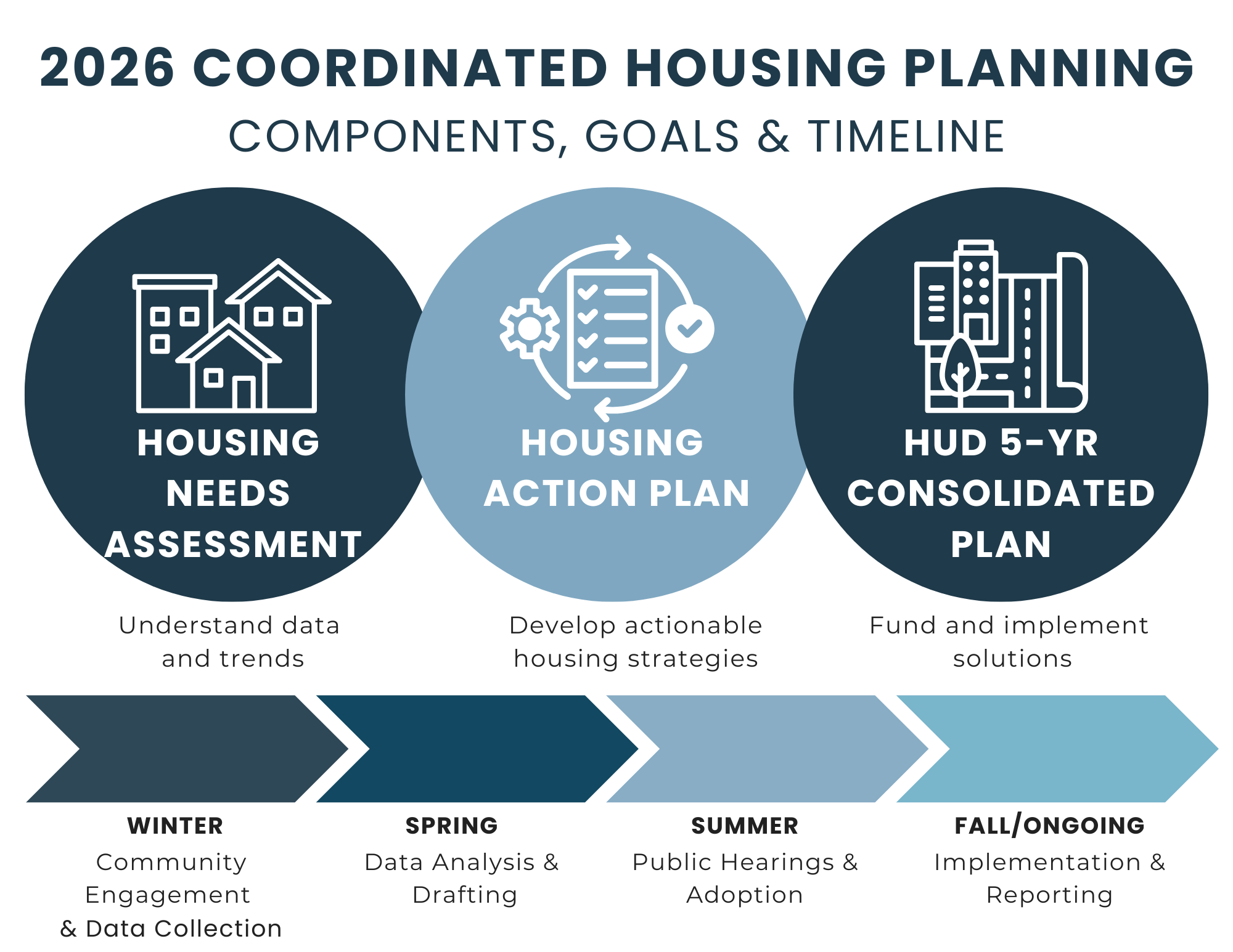
  • Winter 2026: Community kickoff, survey launch, resident focus groups

  • Spring 2026: Continued survey outreach, stakeholder focus groups, data analysis

  • Summer 2026: Public presentation of findings and adoption of the Housing Action Plan and 5-Year Consolidated Plan

Housing Needs Assessment & Local Housing Action Plans

The City of Grand Junction and Mesa County are partnering on a combined Housing Needs Assessment (HNA) to better understand housing conditions, trends, and needs across the region. By working together, the City and County can leverage shared data, regional market insights, and community input to create a more complete picture of local housing challenges and opportunities.

While the Housing Needs Assessment will be completed jointly, the City of Grand Junction and Mesa County will each develop their own separate Housing Action Plans. These plans will reflect the unique roles, responsibilities, and priorities of each jurisdiction, while remaining grounded in the same regional data and community feedback. The Housing Action Plan (HAP) will help identify actionable strategies to improve housing affordability, availability, and stability across the community.

This work will also help inform the City’s 2026–2030 Community Development Block Grant (CDBG) 5-Year Consolidated Plan, ensuring alignment with local, state, and federal requirements. Learn more about the CDBG 5-Year Consolidated Plan.

Community participation is a cornerstone of this effort. Input from residents, stakeholders, service providers, and community partners will directly inform the findings of the Housing Needs Assessment and shape the strategies included in the Housing Action Plan.

How the Community Can Participate

The community engagement process is designed to be inclusive, accessible, and transparent, with multiple ways to participate over several months. Engagement activities include:

Community Kickoff Open House

A public, drop-in open house will launch the process, providing an opportunity to learn about the Housing Needs Assessment, share experiences, and offer feedback on housing priorities and potential solutions. Interactive activities will allow participants to identify housing challenges, discuss tradeoffs, and highlight community needs and assets.

Community Kickoff Open House
๐Ÿ“… February 12, 2026
๐Ÿ•” 5–7 p.m.
๐Ÿ“ Mesa County Library

RSVP (optional)


Community-Wide Housing Survey

A comprehensive housing survey will be available online for multiple months to ensure broad participation. The survey will be offered in English and Spanish and will gather information on housing conditions, affordability, displacement risk, access to services, commuting patterns, and community belonging. Survey responses will be used alongside local and regional data to inform the Housing Needs Assessment.

Take the Community-Wide Housing Survey online.


Resident Focus Groups

As required by State Statute and HUD, to ensure voices that are often underrepresented in planning processes are heard, small, in-person focus groups will be held with specific populations.

Focus groups will include:

  • Spanish-speaking residents

  • Mobile home park residents

Residents with disabilities and those who may require accessible housing or services

If you are a resident who identifies in one of these key areas and would like to participate, please email housing@gjcity.org for more information.


Stakeholder Focus Groups and Interviews

Additional focus groups and interviews will be conducted with housing and community development stakeholders, including:

  • Affordable housing providers and service organizations

  • Developers, builders, lenders, and real estate professionals

  • Public officials and industry leaders

These conversations will help identify barriers, opportunities, and practical strategies to address housing needs at both the local and regional level. Information will be sent out directly to key identified stakeholder groups. If you are a member of one of these groups and would like to participate, please email housing@gjcity.org.


Public Meetings and Presentations

Draft and final results of the Housing Needs Assessment and Housing Action Plan will be presented at public meetings with Grand Junction City Council and the Mesa County Board of Commissioners, as required by state law and federal regulations. Dates TBD


Community Engagement Approach

Community input is central to this effort. The engagement process is designed to be inclusive, accessible, and transparent, and will ensure that residents, stakeholders, service providers, and community partners across both the city and county have meaningful opportunities to participate.

Feedback gathered through this process will:

  • Inform the regional Housing Needs Assessment

  • Shape jurisdiction-specific Housing Action Plans for the City and the County

  • Help guide future housing investments, policies, and funding decisions

The engagement strategy is intentionally flexible and will be refined throughout the process in coordination with City and County staff to respond to community participation and emerging needs.


What This Means for the Community

  • One shared assessment: Residents will contribute to a single, regionally informed Housing Needs Assessment.

  • Local action: The City of Grand Junction and Mesa County will each adopt their own Housing Action Plans based on their respective governance structures, resources, and policy tools.

  • Stronger outcomes: A regional understanding of housing needs paired with locally focused action plans supports more effective, coordinated solutions.


Timeline Snapshot

  • Winter 2026: Community kickoff, survey launch, resident focus groups

  • Spring 2026: Continued survey outreach, stakeholder focus groups, data analysis

  • Summer 2026: Public presentation of findings and adoption of the Housing Action Plan and 5-Year Consolidated Plan


  • Colorado Senate Bill 24-174: What it is and What it Means

    Share Colorado Senate Bill 24-174: What it is and What it Means on Facebook Share Colorado Senate Bill 24-174: What it is and What it Means on Twitter Share Colorado Senate Bill 24-174: What it is and What it Means on Linkedin Email Colorado Senate Bill 24-174: What it is and What it Means link

    Colorado Senate Bill 24-174: What It Is and What It Means

    Colorado Senate Bill 24-174 is a state law adopted in 2024 that establishes consistent housing planning requirements for local governments across Colorado. The goal of the legislation is to improve housing affordability, better understand local and regional housing needs, and ensure that housing planning is informed by data and community input.

    The law creates a statewide framework for how communities assess housing needs, plan for future housing, and align local efforts with state and federal housing goals.


    What SB24-174 Requires of Local Governments

    Housing Needs Assessments

    Most local governments are required to complete a Housing Needs Assessment by December 31, 2026. This assessment must analyze current and future housing needs, including affordability, housing supply, and risk of displacement. Assessments must follow guidance provided by the Colorado Department of Local Affairs (DOLA).

    Communities may choose to complete the assessment independently or partner with neighboring jurisdictions to conduct a regional housing needs assessment.


    Housing Action Plans

    Certain jurisdictions must also adopt a Housing Action Plan by January 1, 2028, and update it at least every six years. Housing Action Plans identify strategies to address the needs outlined in the Housing Needs Assessment and guide future housing policy, programs, and investments.


    Public Engagement Requirements

    SB24-174 emphasizes meaningful public participation. Local governments are expected to involve residents, stakeholders, and community partners throughout the planning process. Engagement must be inclusive and accessible, and it should include opportunities for community members to provide input on housing challenges, priorities, and potential solutions.


    Coordination with Other Planning Efforts

    The law encourages alignment between housing planning and other required plans, including comprehensive plans and federally required planning documents. This helps ensure consistency across local, state, and federal housing and community development efforts.


    State Support and Technical Assistance

    The State of Colorado, through DOLA, provides guidance, tools, and technical assistance to help local governments complete their Housing Needs Assessments and Housing Action Plans. Grant funding may be available to support this work.


    Future Funding Considerations

    Over time, completion of a Housing Needs Assessment and Housing Action Plan may be considered when the State evaluates eligibility or priority for certain housing and planning grants.


    What This Means Overall for Government Entities

    • Housing planning must be data-driven and transparent

    • Community engagement is required, not optional

    • Jurisdictions are encouraged to collaborate regionally

    • Housing strategies must consider affordability and displacement risk

    • Planning efforts should align across local, state, and federal requirements

    • Completing required plans helps position communities for future funding opportunities

  • What is a 5 year Consolidated Plan?

    Share What is a 5 year Consolidated Plan? on Facebook Share What is a 5 year Consolidated Plan? on Twitter Share What is a 5 year Consolidated Plan? on Linkedin Email What is a 5 year Consolidated Plan? link

    What Is a 5-Year Consolidated Plan?

    A 5-Year Consolidated Plan is a federally required planning document that guides how a community will invest certain U.S. Department of Housing and Urban Development (HUD) funds over a five-year period. It serves as both a strategic roadmap and a community accountability tool, ensuring that federal resources are used to address the most pressing local needs.

    For the City, the Consolidated Plan covers a five-year timeframe and establishes priorities for housing, community development, and services for residents with low and moderate incomes.


    Purpose of the Consolidated Plan

    The Consolidated Plan helps the community:

    • Identify priority housing and community development needs

    • Set goals and strategies to address those needs

    • Guide how federal funding will be allocated each year

    • Ensure compliance with federal requirements

    • Align housing, infrastructure, and service investments with community priorities

    The plan is required in order for the City to receive and use federal funding such as Community Development Block Grant (CDBG) funds.


    What the Plan Covers

    The 5-Year Consolidated Plan focuses on several key areas, including:

    • Housing needs (affordability, availability, condition, and displacement risk)

    • Community development needs (infrastructure, public facilities, and neighborhood improvements)

    • Homelessness and housing stability

    • Economic opportunity and access to services

    • Fair housing and equity

    The plan uses a combination of data analysis, community input, and stakeholder engagement to determine priorities.


    Connection to Other Housing Planning Efforts

    The Consolidated Plan is closely aligned with the Housing Needs Assessment (HNA) and Housing Action Plan (HAP). Findings from the Housing Needs Assessment help identify priority needs, while strategies in the Housing Action Plan inform how funding and programs can be targeted over the five-year period.

    By coordinating these efforts, the City ensures that federal investments are data-driven, locally informed, and aligned with broader housing strategies.


    Community Participation

    Public engagement is a required and essential part of the Consolidated Plan process. Residents and stakeholders are invited to participate through:

    • Public meetings and open houses

    • Community surveys

    • Focus groups and stakeholder discussions

    • Public review and comment periods

    Community feedback directly influences the priorities and goals outlined in the plan.


    How the Plan Is Used

    Once adopted, the 5-Year Consolidated Plan:

    • Guides annual funding decisions

    • Establishes measurable goals and outcomes

    • Helps track progress and report results to HUD

    • Serves as a foundation for future housing and community development initiatives

Page published: 21 Jan 2026, 07:10 AM