

What is Affordable Housing?
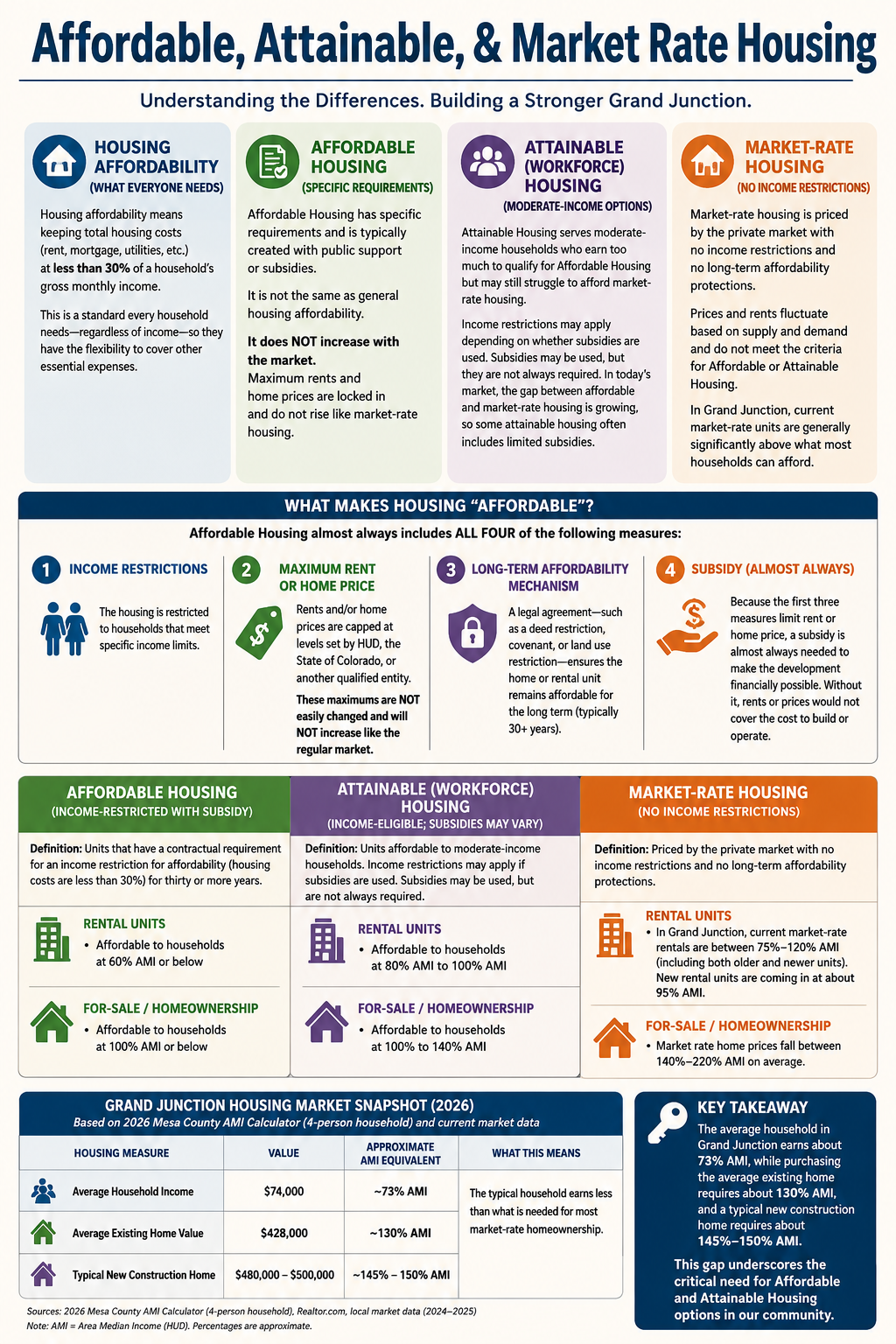
Understanding Housing Affordability, Affordable Housing, Attainable Housing, and Market-Rate Housing
Housing is one of the most frequently discussed topics in Grand Junction, but terms like housing affordability, affordable housing, attainable housing, and market-rate housing are often used interchangeably—even though they mean very different things. Understanding these differences helps explain why communities invest in a variety of housing types and why no single solution addresses every household's needs.
Housing Affordability: Something Everyone Needs
Housing affordability is a financial concept—not a type of housing.
In general, housing is considered affordable when a household spends no more than 30% of its gross monthly income on housing costs, including rent or mortgage payments, insurance, taxes, utilities, and other required housing expenses.
This 30% guideline is used by the U.S. Department of Housing and Urban Development (HUD) because it allows households to have enough income remaining to pay for other necessities such as:
Food
Transportation
Childcare
Healthcare
Savings and emergencies
When households spend more than 30% of their income on housing, they are considered cost-burdened. Households spending more than 50% of their income on housing are considered severely cost-burdened, placing them at greater risk of financial hardship and housing instability.
Housing affordability is important for every household, regardless of income.
Affordable Housing
While everyone needs affordable housing costs, Affordable Housing (capitalized) refers to a specific type of housing with legally defined requirements.
Affordable housing is designed for lower-income households and almost always includes public investment because the housing cannot generally be built or operated using market rents or home prices alone.
Affordable housing typically includes four key characteristics:
1. Income Restrictions
Residents must meet established income limits to qualify.
These limits are typically based on Area Median Income (AMI) and are verified before occupancy.
2. Maximum Rent or Home Price
Affordable housing has maximum rents or sales prices established by HUD, the State of Colorado, or another funding agency.
Unlike market-rate housing, these rents and prices do not simply increase because the real estate market increases.
While annual adjustments may occur based on program rules or updated AMI calculations, the rent or sales price remains regulated to preserve affordability and cannot increase at normal market rates.
3. Long-Term Affordability
Affordable housing includes a legally binding affordability requirement such as:
Deed Restrictions
Covenants
Land Use Restriction Agreements (LURAs)
Other recorded affordability agreements
These legal mechanisms generally keep housing affordable for 30 years or longer, and in many cases permanently.
4. Public Subsidy
Because affordable housing has income limits, regulated rents or home prices, and long-term affordability requirements, the revenue generated by the project is often insufficient to cover the full cost of construction and financing.
For that reason, affordable housing almost always relies on one or more funding sources such as:
Low Income Housing Tax Credits (LIHTC)
State or federal grants
Local government assistance
Housing trust funds
Tax-exempt bonds
Housing Choice Vouchers
Other public or nonprofit financing
Without these funding sources, many affordable housing developments would not be financially feasible.
Attainable (Workforce) Housing
Attainable housing serves households that earn too much to qualify for many affordable housing programs but still cannot reasonably afford today's housing market.
Many attainable housing residents are the people who keep our community functioning, including:
Teachers
Police officers
Firefighters
Healthcare workers
Construction workers
Hospitality employees
Administrative staff
Service industry workers
Young professionals
First-time homebuyers
Unlike affordable housing, attainable housing may or may not include public subsidies.
Some attainable housing developments are built without government assistance. However, as the gap between development costs and market affordability continues to grow, many attainable housing developments now receive limited public support through incentives such as:
Impact fee reductions
Infrastructure assistance
Public land partnerships
Low-interest financing
Limited grants
Depending on the funding source, some attainable housing developments also include income restrictions, while others simply target moderate-income households through pricing.
Market-Rate Housing
Market-rate housing is housing whose price is determined entirely by supply and demand.
Unlike affordable or attainable housing, market-rate housing generally:
Has no income restrictions
Has no maximum rent or sales price
Has no long-term affordability requirements
Typically receives no public affordability subsidy
Because prices respond directly to the real estate market, rents and home prices increase (or decrease) as market conditions change.
Market-rate housing plays an important role in meeting overall housing demand, but it is not specifically designed to serve households with affordability challenges.
Current Market Conditions in Grand Junction
Current market data illustrates where market-rate housing generally falls today:
Rental Housing
Existing and newer market-rate apartments typically serve households earning approximately 75%–120% AMI.
Newly constructed apartment communities generally target households around 95% AMI.
Homeownership
Average existing home values generally require incomes around 130% AMI.
Typical new construction homes generally require incomes between 145% and 150% AMI, with many new homes falling within a broader market range of 140%–220% AMI.
What is Area Median Income (AMI)?
Area Median Income (AMI) is the midpoint of household incomes for a region and is calculated annually by the U.S. Department of Housing and Urban Development (HUD).
AMI is adjusted based on household size and serves as the standard used by most housing programs to determine eligibility and affordability.
Housing programs frequently reference percentages of AMI because they provide a consistent way to compare housing affordability across different income levels.
Grand Junction's Housing Definitions
In August 2023, the Grand Junction City Council adopted Resolution 65-23, establishing the City's definitions for Affordable and Attainable Housing.
Affordable Housing
Affordable Housing includes units with a contractual affordability requirement lasting 30 years or more.
Rental Housing
Affordable to households earning 60% AMI or below
Homeownership
Affordable to households earning 100% AMI or below
Attainable (Workforce) Housing
Rental Housing
Affordable to households earning approximately 80% to 100% AMI
Homeownership
Affordable to households earning approximately 100% to 140% AMI
Why Does This Matter?
One of the biggest challenges facing Grand Junction is the growing gap between what households earn and what housing costs.
Using current 2026 data:
| Measure | Approximate AMI |
|---|---|
| Average Grand Junction household income | ~73% AMI |
| Average existing home | ~130% AMI |
| Typical newly constructed home | ~145–150% AMI |
This means the average Grand Junction household earns significantly less than the income generally needed to purchase today's average home or a newly built home.
Closing that gap requires a balanced housing strategy that includes:
Preserving existing affordable housing
Building new affordable housing
Expanding attainable/workforce housing
Supporting market-rate housing production
Encouraging housing choices across all income levels
Together, these efforts help ensure Grand Junction remains a community where residents of all incomes can live, work, and thrive.

Thank you for your contribution!
Help us reach out to more people in the community
Share this with family and friends