Salt Flats Project
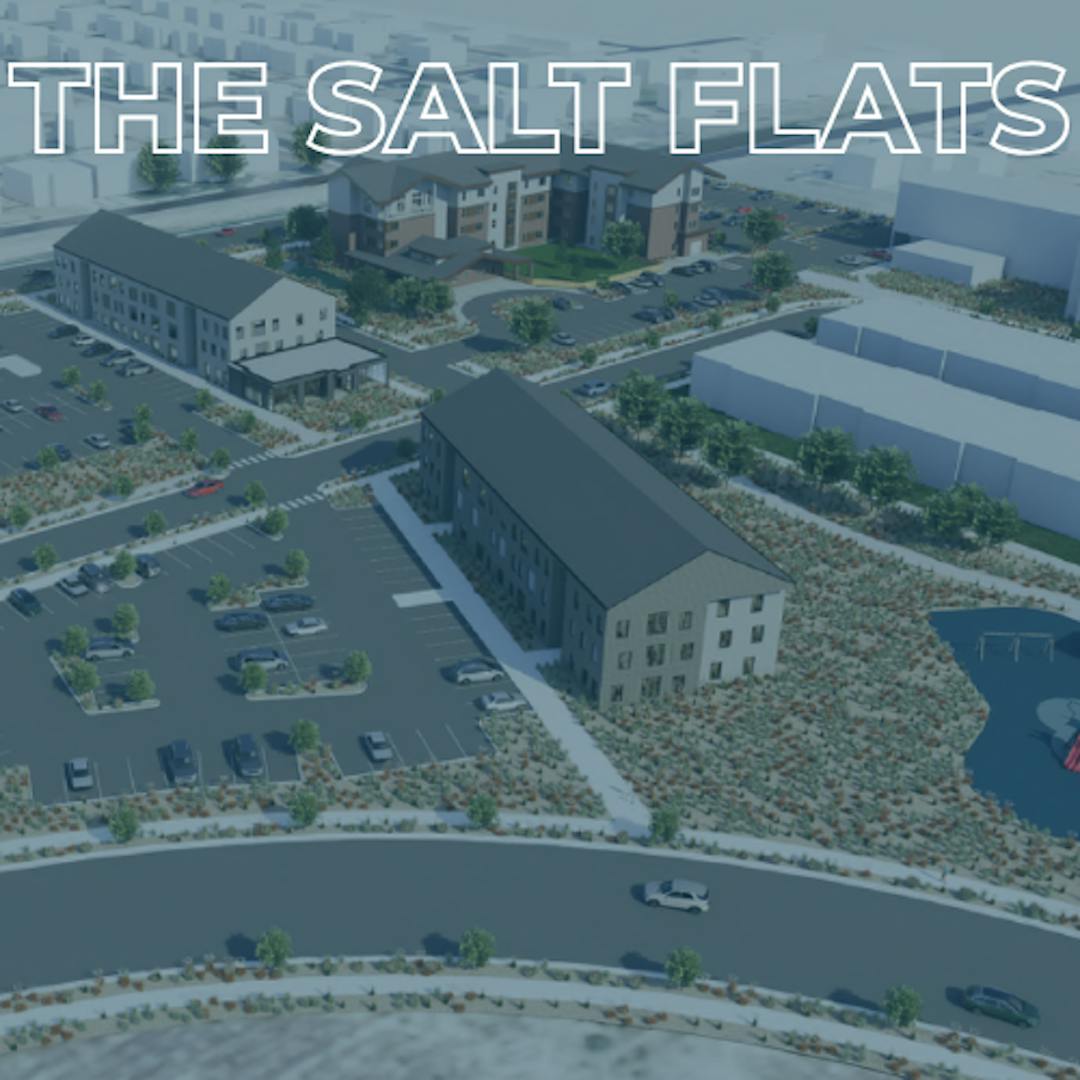
This project page acts as a platform for community members to be informed and learn about the upcoming next steps for the development of the Salt Flats property.
Project Overview
The Salt Flats Project is more than just housing — it’s about building the future of Grand Junction. This 21.78-acre site, once underutilized, is being transformed into a neighborhood designed to meet the community housing needs.
At its heart, the Salt Flats Project will deliver between 324 and 550 new homes, blending affordable options with attainable and market-rate homes in both rental and homeownership opportunities for local families. This mix is intentional: by combining public investment with private development, the project creates stability for families and seniors while also encouraging new opportunities for local builders, businesses, and investors.
Why It Matters
In recent years, high interest rates and rising construction costs have increased housing costs across the country. Grand Junction has felt these impacts, leaving fewer options for local renters and buyers. The City is removing barriers to development — investing in the infrastructure, planning, and groundwork that make it easier for the private market to deliver homes. This means developers can focus on building high-quality housing that serves a wide range of people in our community.
A Neighborhood for Everyone
Salt Flats is designed to be a place where neighbors can thrive. With plans for a neighborhood park, open space, and its location near bus stops, jobs, and services means residents this development isn’t just about homes — it’s about creating a community. Residents will have easy access to the things that make life in Grand Junction more affordable.
Community-Driven Growth
This project represents a once-in-a-generation chance to guide growth in a way that benefits everyone. By combining affordable housing with private development, Salt Flats strengthens our economy, supports local businesses, and ensures that Grand Junction remains a place where teachers, nurses, first responders, service workers, and young families can live alongside retirees and professionals.
-
Juniper Grove: Homeownership Opportunities at the Salt Flats with Rural Homes
Share Juniper Grove: Homeownership Opportunities at the Salt Flats with Rural Homes on Facebook Share Juniper Grove: Homeownership Opportunities at the Salt Flats with Rural Homes on X (formerly Twitter) Share Juniper Grove: Homeownership Opportunities at the Salt Flats with Rural Homes on Linkedin Email Juniper Grove: Homeownership Opportunities at the Salt Flats with Rural Homes link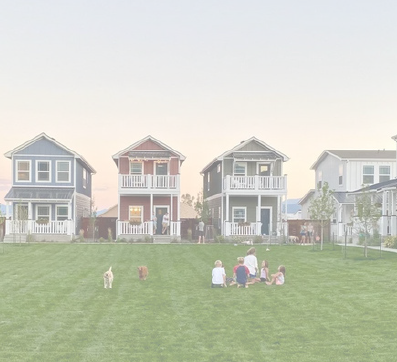
 Rural Homes at the Salt Flats
Rural Homes, a Western Slope affordable housing developer, is bringing forward new for-sale homeownership opportunities as part of the 21.78-acre Salt Flats Plan. This phase of the project is designed to help working families and individuals build equity and long-term stability by expanding access to affordable homeownership in Grand Junction.
The proposed plan features 48 lots: 10 single-family detached homes and 38 duplex homes, each with two on-lot parking spaces. The community has been thoughtfully designed to include a variety of housing types, with both alley-loaded and front-loaded configurations that create a dynamic and visually appealing neighborhood. They are also exploring the integration of a small-scale family home childcare centers within a few units to serve working families.
The Rural Homes project will serve households earning below 100% of Area Median Income (AMI), with long-term deed restrictions to ensure permanent affordability. See “Affordability at the Salt Flats” for more details on purchase price restrictions and income qualifications.
Who are the Partners?
Rural Homes: Rural Homes is a nonprofit community housing developer dedicated to expanding homeownership opportunities in rural and mountain communities across Colorado. With projects in Ouray, Gunnison, and Pagosa Springs, Rural Homes has a proven track record of delivering high-quality, energy-efficient homes at attainable price points. Their model leverages partnerships with local governments, employers, and philanthropic organizations to bring forward for-sale housing that is both affordable and community-rooted.
To learn more, visit the “Meet the Development Team: Rural Homes” page (COMING SOON!) or their website: https://ruralhomes.co/
Rural Homes is partnering with Fading West Development, a Colorado-based housing solutions company that operates one of the state’s leading modular housing factories in Buena Vista. Fading West specializes in designing and producing high-quality, energy-efficient modular homes at scale, dramatically reducing construction costs and timelines while maintaining durability and design flexibility.
Through this partnership, Rural Homes can leverage Fading West’s innovative modular construction process to deliver deed-restricted, for-sale homes more quickly and at lower cost. This collaboration represents a significant opportunity for Grand Junction, as modular housing has the potential to transform the affordability landscape by addressing supply shortages, streamlining delivery, and ensuring long-term homeownership opportunities for local families.
What will it include?
Unit Mix: Approximately 48 for-sale homes, including townhomes and small-lot single-family cottages.
Workforce-Oriented Homeownership: Designed to serve households earning below 100% AMI, the homes will create pathways to ownership for teachers, first responders, healthcare workers, and other members of the local workforce.
Energy Efficiency & Design: Homes will be built to high efficiency standards, lowering operating costs for homeowners and meets the requirements for the site set forth through the Landbanking Grant.
Permanent Affordability: Homes will carry long-term deed restrictions ensuring affordability for future buyers, preserving this critical resource in perpetuity.
How Is it Being Financed?
The Rural Homes development will be supported through a blend of local, state, and philanthropic resources:
Private and Public Partnerships: Development will leverage down payment assistance, below-market financing, and local employer participation to reduce costs for buyers.
Proposition 123 Homeownership Development Grant: Funding will be sought to lower sales prices and expand access to households traditionally priced out of homeownership.
City Affordable/Attainable Housing Incentive Program: The project has applied for the Affordable/Attainable Housing Incentive Program that provides Impact fee waivers tied to long-term affordability deed restrictions. Learn more about the City's program here.
Philanthropy and Employer Support: Modeled after Rural Homes’ successful projects in other Colorado communities, the Salt Flats homes will also rely on local partnerships to strengthen financial feasibility and broaden impact.
Next Steps
The Rural Homes site is already incorporated into the Salt Flats Master Plan and zoned appropriately for for-sale residential development. Predevelopment activities, including site design and financing applications, are underway.
If funding and approvals align, construction is anticipated to begin in 2026, with the first homes available for purchase in 2027.
Why it Matters
Rural Homes at the Salt Flats will expand homeownership opportunities in Grand Junction for families earning below 100% AMI who are currently priced out of the housing market. By pairing affordable purchase prices with long-term deed restrictions, the project ensures today’s investment remains accessible for generations.
Particularly as homeownership plays a vital role in strengthening both households and local economies. For families, owning a home provides stability, the ability to build equity, and a pathway to long-term financial security. It often means predictable housing costs, a sense of pride, and the opportunity to pass wealth on to future generations.
At the community level, higher rates of homeownership support stronger neighborhoods, increased civic engagement, and local economic growth as families invest in their homes and communities. By creating more attainable pathways to ownership, we not only help individual households thrive but also build healthier, more resilient local economies.
Together with the rental opportunities provided by The Ascent and other partners, Rural Homes’ homeownership development contributes to the creation of a balanced, mixed-income community at the Salt Flats—one that supports renters, first-time buyers, and growing families alike.
-
The Ascent at the Salt Flats - an affordable rental housing community for families
Share The Ascent at the Salt Flats - an affordable rental housing community for families on Facebook Share The Ascent at the Salt Flats - an affordable rental housing community for families on X (formerly Twitter) Share The Ascent at the Salt Flats - an affordable rental housing community for families on Linkedin Email The Ascent at the Salt Flats - an affordable rental housing community for families link
The Ascent at the Salt Flats
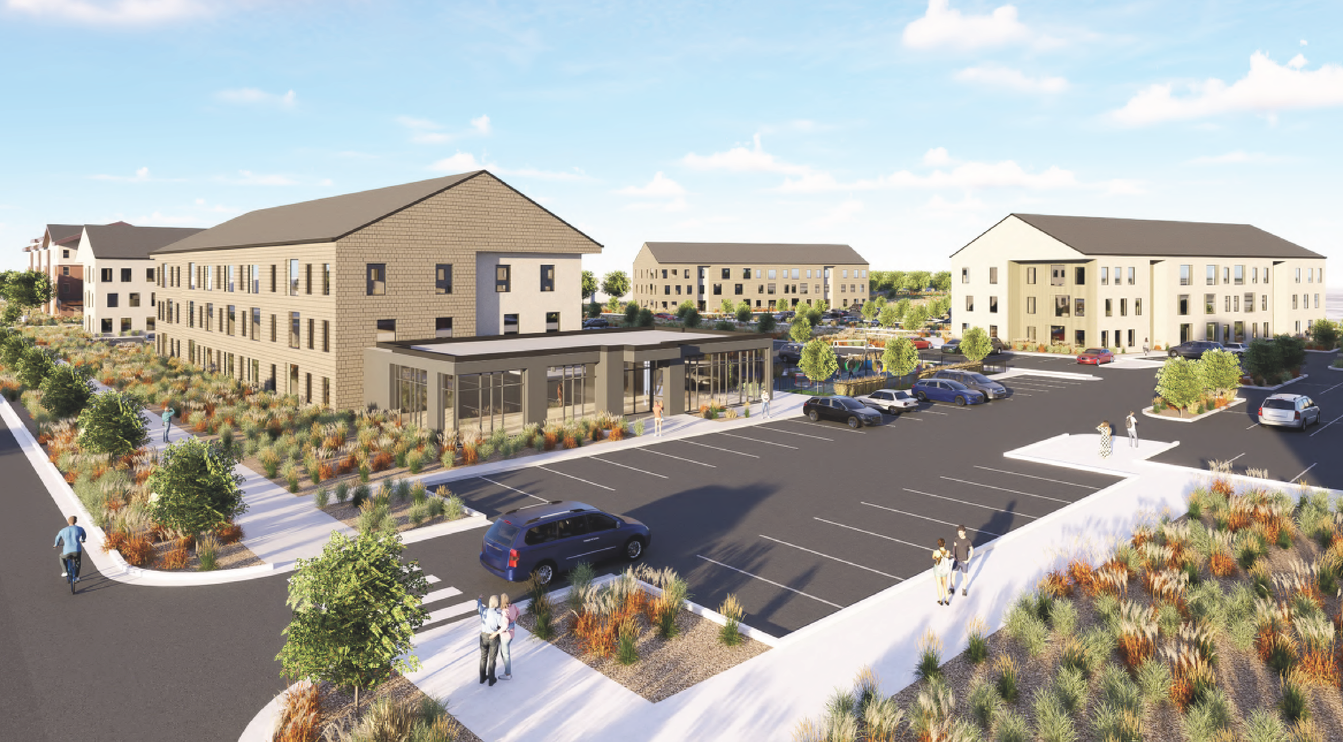
The Ascent at the Salt Flats, a new144-unit affordable rental housing community designed for individuals and families across a range of incomes is being planned as part of the Salt Flats Project. Located within the 21.78-acre Salt Flats Master Plan, the project will provide a diverse mix of studios through four-bedroom units serving households between 30%–70% of Area Median Income (AMI), with a community average of 58% AMI. See "Affordability at the Salt Flats" for more details on maximum rents, restrictions on income, etc.
Who are the Partners?
Brikwell: Brikwell is a Colorado-based real estate development company specializing in affordable, workforce, and market-rate housing. With a focus on creating mixed-income communities, Brikwell brings expertise in planning, financing, and delivering high-quality housing projects that balance affordability with long-term sustainability. The firm has experience navigating state and federal housing programs, including Low-Income Housing Tax Credits (LIHTC) and Private Activity Bonds (PAB), and works closely with public and nonprofit partners to maximize resources and deliver attainable housing solutions. Brikwell will maintain ownership and management of the Ascent.To learn more, visit the "Meet the Development Team: Brikwell" page or visit their website at: https://brikwell.com/
What will it include?- Unit Mix: 44 studios, 44 one-bedrooms, 20 two-bedrooms, 24 three-bedrooms, and 12 four-bedrooms.
- Entry Level:44 units (31%) studio units to provide an entry point for individuals and small families looking to establish their household. There are currently zero affordable studio housing units in Grand Junction as 82% of the current affordable housing is one- and two- bedroom.
-
Larger Family Housing: 36 units (25%) are three- and four-bedroom to accommodate larger
families, addressing a growing, unmet need in affordable housing. Only 18% of affordable housing units
in Grand Junction are three- and four- bedroom.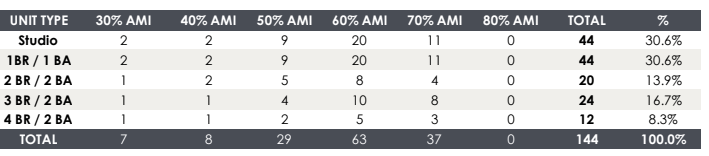 Focus on Gaps: Adds the community’s first affordable studios (31% of units) and a strong share of three- and four-bedrooms (25%), directly addressing unmet needs in Grand Junction’s affordable housing supply.
Early Childhood Education Center: A 3,100 SF on-site center with an adjacent 5,000 SF playground, developed in partnership with Wildflower Montessori and supported by United Way Mesa County, serving up to 60 children.
How Is it Being Financed?
The project is funded through a combination of state and federal affordable housing programs along with private investment. The development team will utilize 4% and 9% Federal and State Low-Income Housing Tax Credits (LIHTC), a non-competitive tax credit program administered by the Colorado Housing and Finance Authority (CHFA). LIHTC is one of the most important tools for creating affordable housing, as it provides tax incentives that lower development costs and allow rents to remain affordable for low- and moderate-income households.
To pair with the tax credits, the City of Grand Junction and Mesa County are contributing their Private Activity Bond (PAB) allocations to the Salt Flats. PABs are federally authorized tax-exempt bonds issued by state and local governments for qualified projects, including affordable housing. In housing developments, PABs are particularly significant because they unlock access to 4% LIHTC, making it possible to finance large-scale rental projects that otherwise would not pencil out. By committing local PAB allocations, the City and County are directly enabling the Salt Flats project to move forward with hundreds of affordable units that meet critical community needs.
In addition, the project benefits from its location in a Qualified Census Tract (QCT), increasing competitiveness for certain funding resources, and has applied for the City’s Affordable Housing Incentive Program, which provides municipal fee waivers in exchange for long-term affordability deed restrictions.
Next Steps
The project is zoned by right for multifamily apartments and already has PAB allocations totaling ~$18.7M, covering 43.7% of eligible basis for tax credits.
Why it Matters
Ascent at the Salt Flats will expand affordable housing options in Grand Junction by providing high-quality, energy-efficient apartments and on-site services in a walkable, transit-connected community. By prioritizing both small households and large families, and by integrating supportive amenities like early childhood education, the project advances the City’s housing goals and sets the stage for a more equitable, inclusive Salt Flats neighborhood.


-
"Haven at the Salt Flats" Senior & Veteran Housing by Volunteers of America
Share "Haven at the Salt Flats" Senior & Veteran Housing by Volunteers of America on Facebook Share "Haven at the Salt Flats" Senior & Veteran Housing by Volunteers of America on X (formerly Twitter) Share "Haven at the Salt Flats" Senior & Veteran Housing by Volunteers of America on Linkedin Email "Haven at the Salt Flats" Senior & Veteran Housing by Volunteers of America link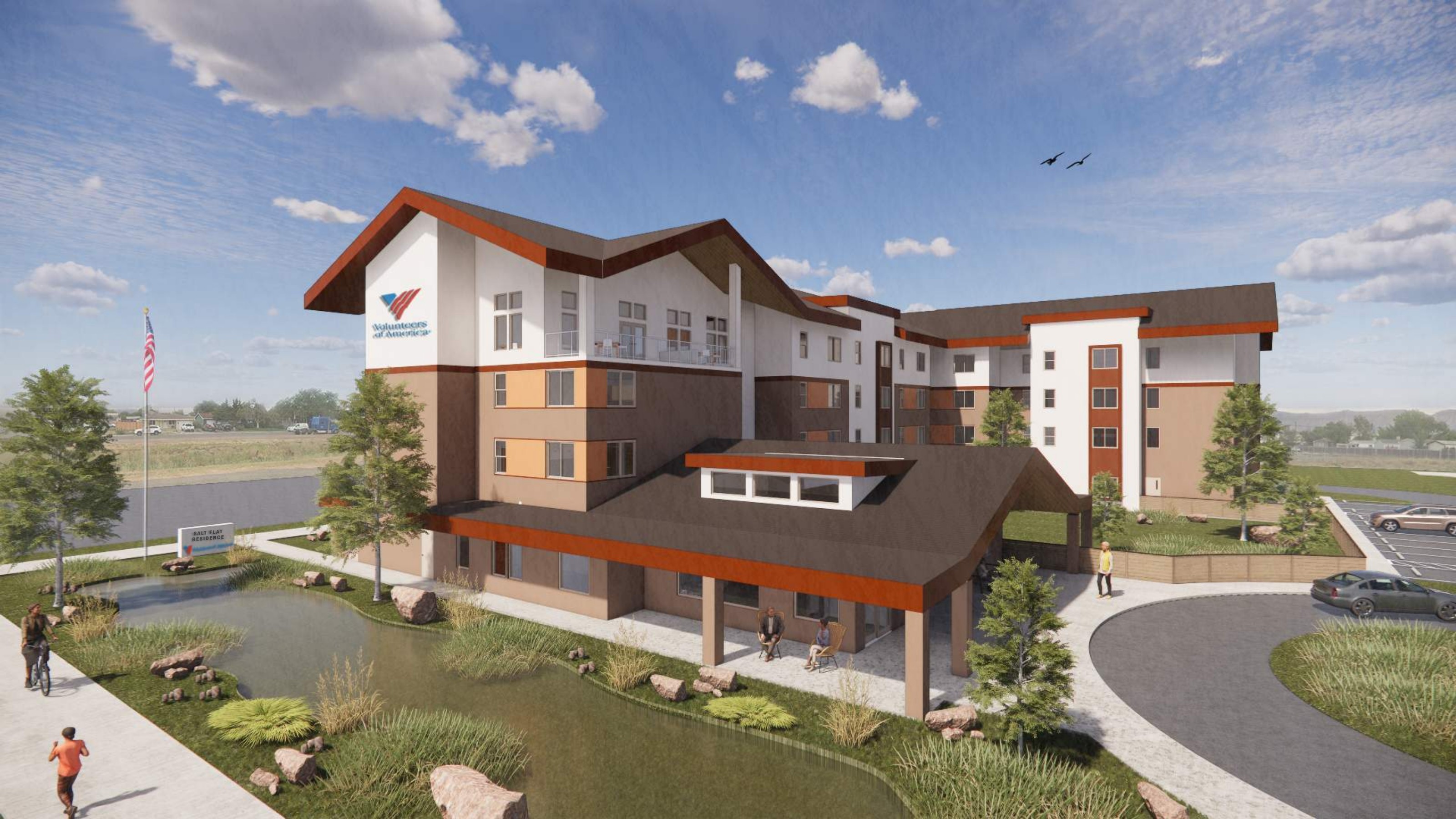

New Senior & Veteran Housing at Salt Flats
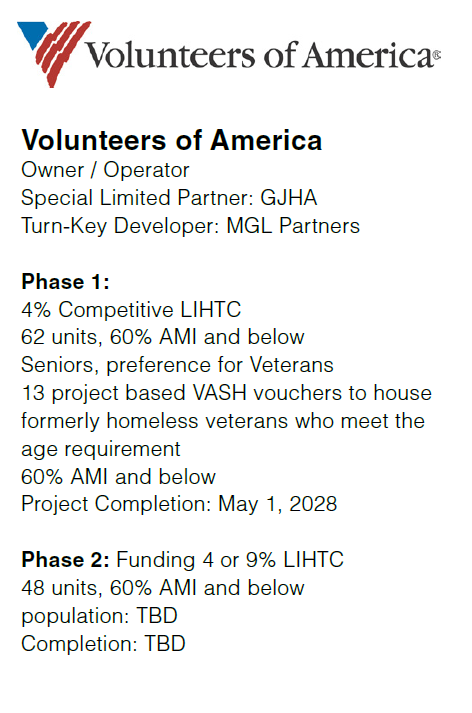
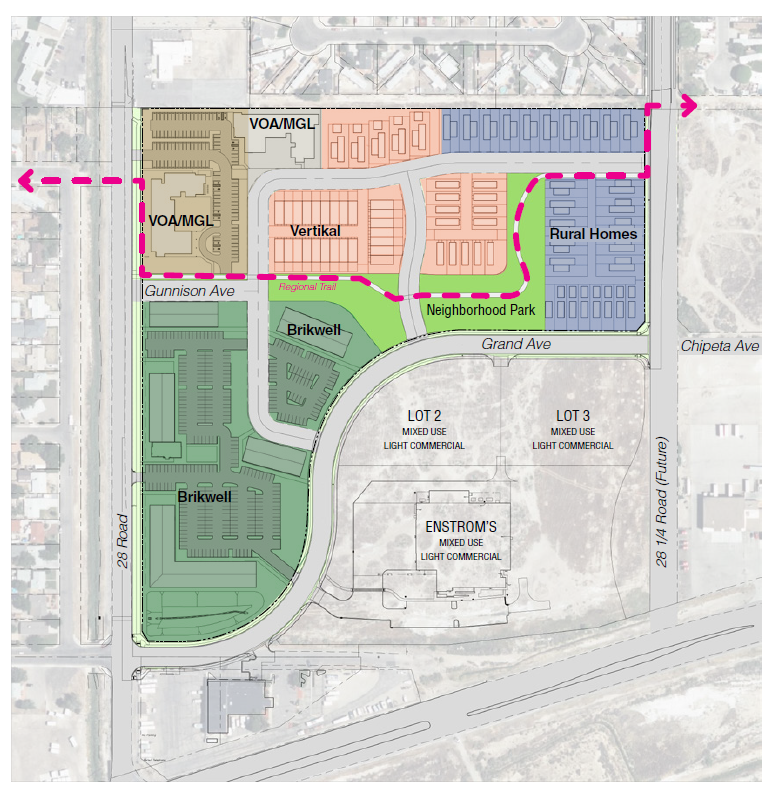
A new housing community for older adults (55+) and veterans is being planned as part of the Salt Flats project. The Grand Junction Housing Authority selected Volunteers of America (VOA) and their partner MGL Partners to build and manage this housing on about 3 acres of the Salt Flats property. In June 2025, the City signed a 99-year no-cost land lease with VOA to make the project possible.
Who are the Partners?
Volunteers of America (VOA): A respected national nonprofit with a strong presence in Colorado. VOA builds and manages affordable housing and also provides services to seniors, veterans, and families. In this project, VOA will be the property owner, long-term manager, and provider of on-site resident services.
MGL Partners: A Colorado-based real estate development firm that specializes in affordable and workforce housing. MGL brings expertise in planning, financing, and construction, serving as the turnkey developer for this project.
How is it being financed?
The project is funded through a mix of state and federal affordable housing programs along with private investment. On August 1, 2025, the partnership applied to the Colorado Housing and Finance Authority (CHFA) for 4% Federal and State Low-Income Housing Tax Credits (LIHTC). These tax credits are a critical financing tool used nationwide to lower development costs and keep rents affordable. See the "Affordability at the Salt Flats" under the Project Information for more details on maximum rents, restrictions on income, etc.
In addition, the project is located in a Qualified Census Tract (QCT), which increases its ability to compete for resources, and it has applied for the City’s Affordable Housing Incentive Program, which eliminates City's fees and costs for affordable projects for a long term deed restriction requirement. The Grand Junction Housing Authority will also participate as a Special Limited Partner, which provides eligibility for certain tax exemptions.
What will it include?
The new community will feature 62 apartments, with 13 apartments reserved for veterans through the Veterans Affairs Supportive Housing (VASH) program. The apartments will serve households earning up to 60% of the Area Median Income (AMI) — about $50,000 a year for a two-person household.
Unit Mix: 50 one-bedroom and 12 two-bedroom apartments.
Amenities: Community room, counseling and service offices, outdoor courtyard with BBQ and gardens, and on-site parking.
-
Apartment Features: In-unit washer/dryer, full kitchens with Energy Star appliances, central air, storage, and internet hookups.
Next Steps
VOA and MGL are currently awaiting award notifications for the State’s LIHTC funding. If funding is awarded, the project anticipates breaking ground in Winter 2027, with units expected to be ready for move-in around Spring 2028.
Future Phase
As part of the 99-year lease, Volunteers of America has also committed to building a second housing community on the site within the next seven years. This future phase, located on the northeast corner of VOA’s 2.91 acres, is expected to include approximately 48 additional apartments for households earning 60% AMI and below.
The exact population to be served and construction timeline will be determined based on community needs at the time of development. Funding is anticipated to come through either the 4% or 9% Low-Income Housing Tax Credit (LIHTC) program.
Why it matters
This project will create high-quality, service-enriched housing that meets the needs of seniors and veterans on the Western Slope. With strong nonprofit and private partners, robust financing tools, and long-term affordability requirements, the community will remain a stable and welcoming place for decades to come.
-
Infrastructure - Roads, Water, Sewer, Parks, Buses and Utilities at the Salt Flats
Share Infrastructure - Roads, Water, Sewer, Parks, Buses and Utilities at the Salt Flats on Facebook Share Infrastructure - Roads, Water, Sewer, Parks, Buses and Utilities at the Salt Flats on X (formerly Twitter) Share Infrastructure - Roads, Water, Sewer, Parks, Buses and Utilities at the Salt Flats on Linkedin Email Infrastructure - Roads, Water, Sewer, Parks, Buses and Utilities at the Salt Flats linkInfrastructure
One of the main reasons the Salt Flats property sat vacant for so many years was the extraordinary cost of infrastructure. For decades, the site lacked the water, sewer, and roadway connections needed to make housing feasible. To prepare more than 21 acres for development required not just pipes and pavement, but also coordinated planning with City Engineering to ensure that future homes would have reliable access to water, sewer, storm drainage, streets, and sidewalks.
For the development community, in general, infrastructure costs were identified as a major barrier to the development of affordable and workforce housing. Without upfront investment, developers could not make the numbers work — especially for affordable housing, where rents and sale prices must remain capped for 30, 40 or more years. Learn more about Affordability on the Salt Flats. As a result, the site remained vacant, despite being one of the remaining large parcels of undeveloped land in the downtown area.
To overcome this challenge, the City pursued outside funding. In November 2024, the City was awarded $2 million through the “More Housing Now” grant program, part of the Energy and Impact Assistance Fund (EIAF). This was paired with an $800,000 local match allowing the City to cover the backbone infrastructure costs that had long prevented development. Additionally, negotiated in the purchase of the property, the seller contributed an additional $1 million towards the infrastructure.
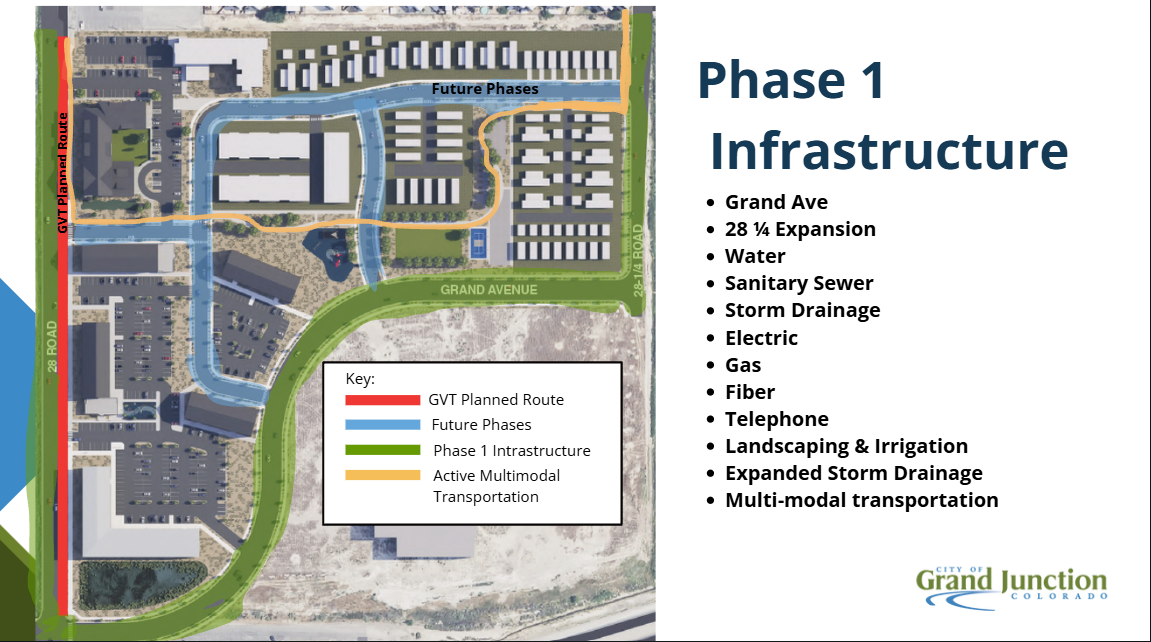
Phase 1 Infrastructure began in August 2025 and focuses on the essentials: improving 28 Road and Grand Avenue connections, adding a road at 28-1/4 Rd, installing new water and sewer lines, electricity lines, and adding storm drainage. Residents may notice some traffic delays along 28 Road while this work is underway. Phase 1 is expected to be completed by late 2025, laying the groundwork for the initial housing construction to begin.
Phase 2 Infrastructure is now in the planning stage. This phase will extend into the site, building the internal streets, sidewalks, and bike lanes needed to serve new homes and create a well-connected neighborhood. These improvements will be tailored as the unit mix and development plans are finalized with project partners.
By tackling infrastructure first, the City has turned a long-standing barrier into a catalyst for housing. With backbone systems in place, private developers can step in to deliver a mix of affordable, attainable, and market-rate homes — fulfilling a key Housing Strategy and transforming the Salt Flats into a thriving new community.
The Opportunity for a Neighborhood Park
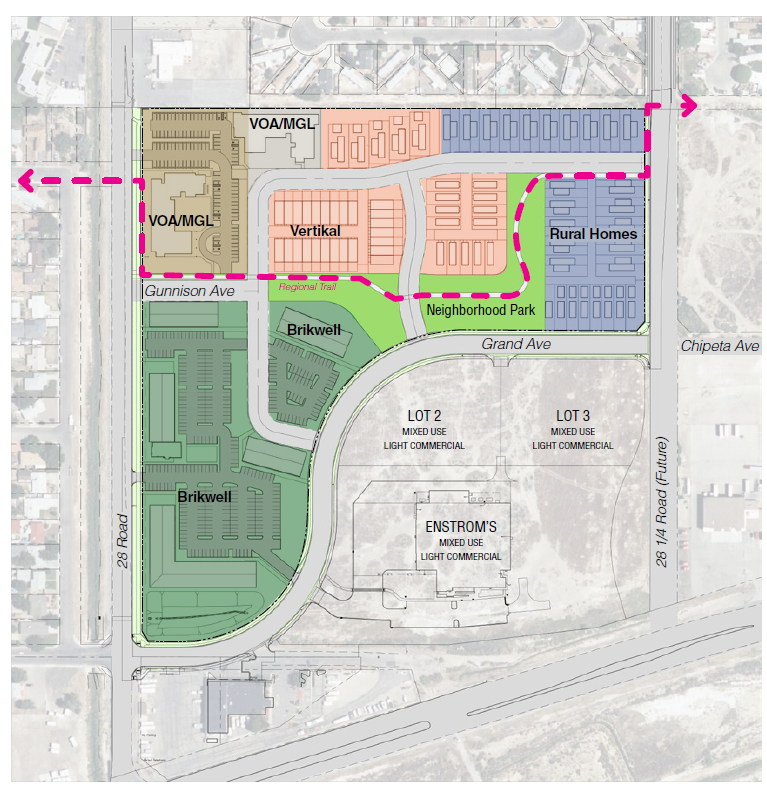
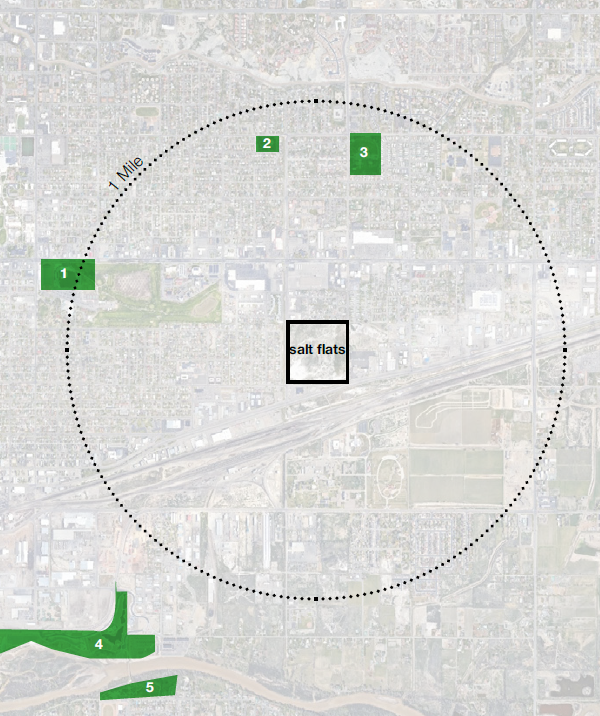
As shown in the map, there are no existing parks located immediately within the Salt Flats area. While several parks such as Lincoln Park, Rocket Park, and Columbine Park sit just over a mile away, the lack of a nearby green space highlights the opportunity for a new community park at Salt Flats.
A neighborhood park here would not only serve the residents of the Salt Flats development but also benefit the surrounding neighborhoods, creating a much-needed gathering place for recreation, play, and community connection.
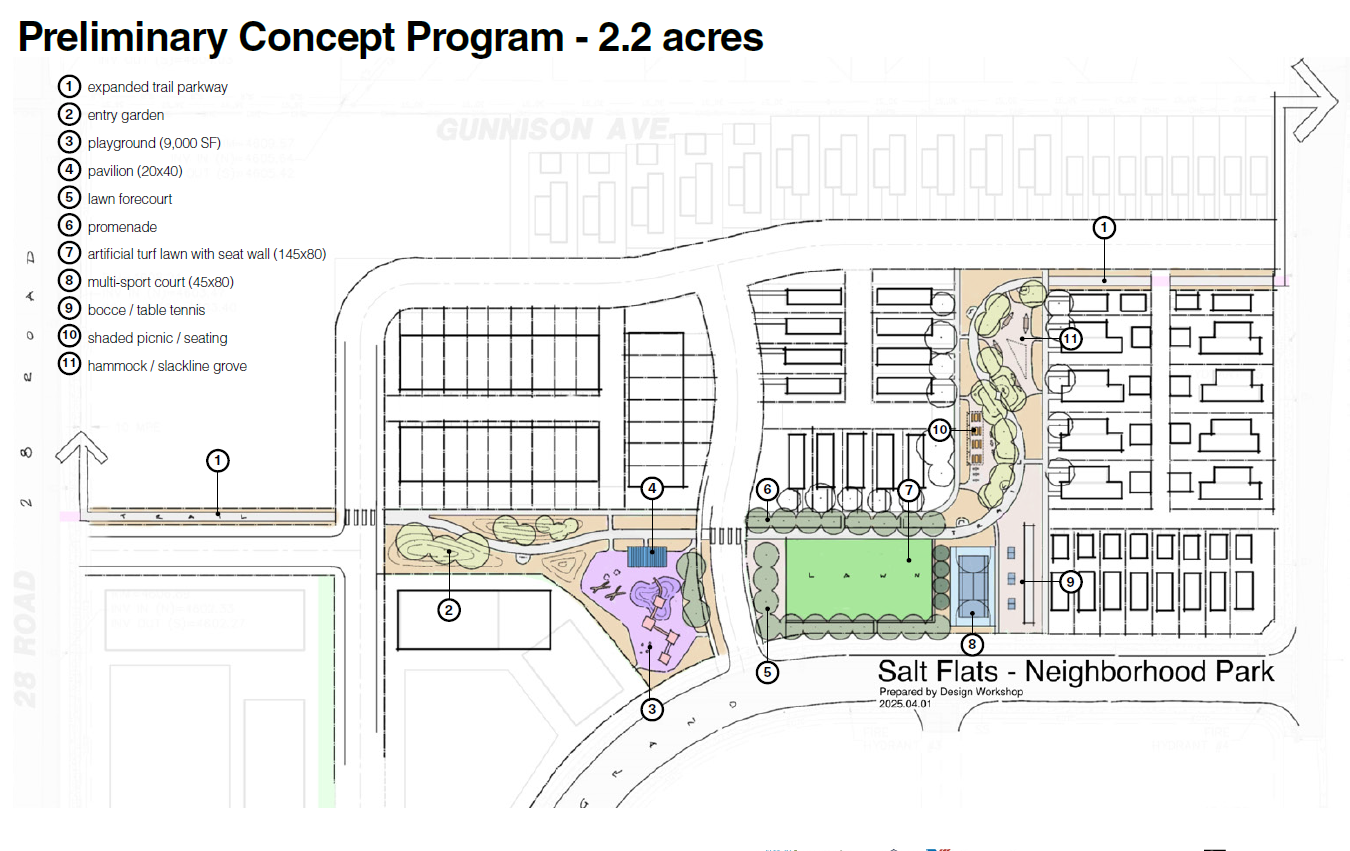
An early concept design may include open lawns, play areas, picnic shelters, walking paths, and other family-friendly amenities. However, before any final decisions are made, the City Parks and Recreation Department and Brikwell, the master developer, will seek input from the community to ensure the park reflects local priorities and needs.
Expanding Transit Access at Salt Flats
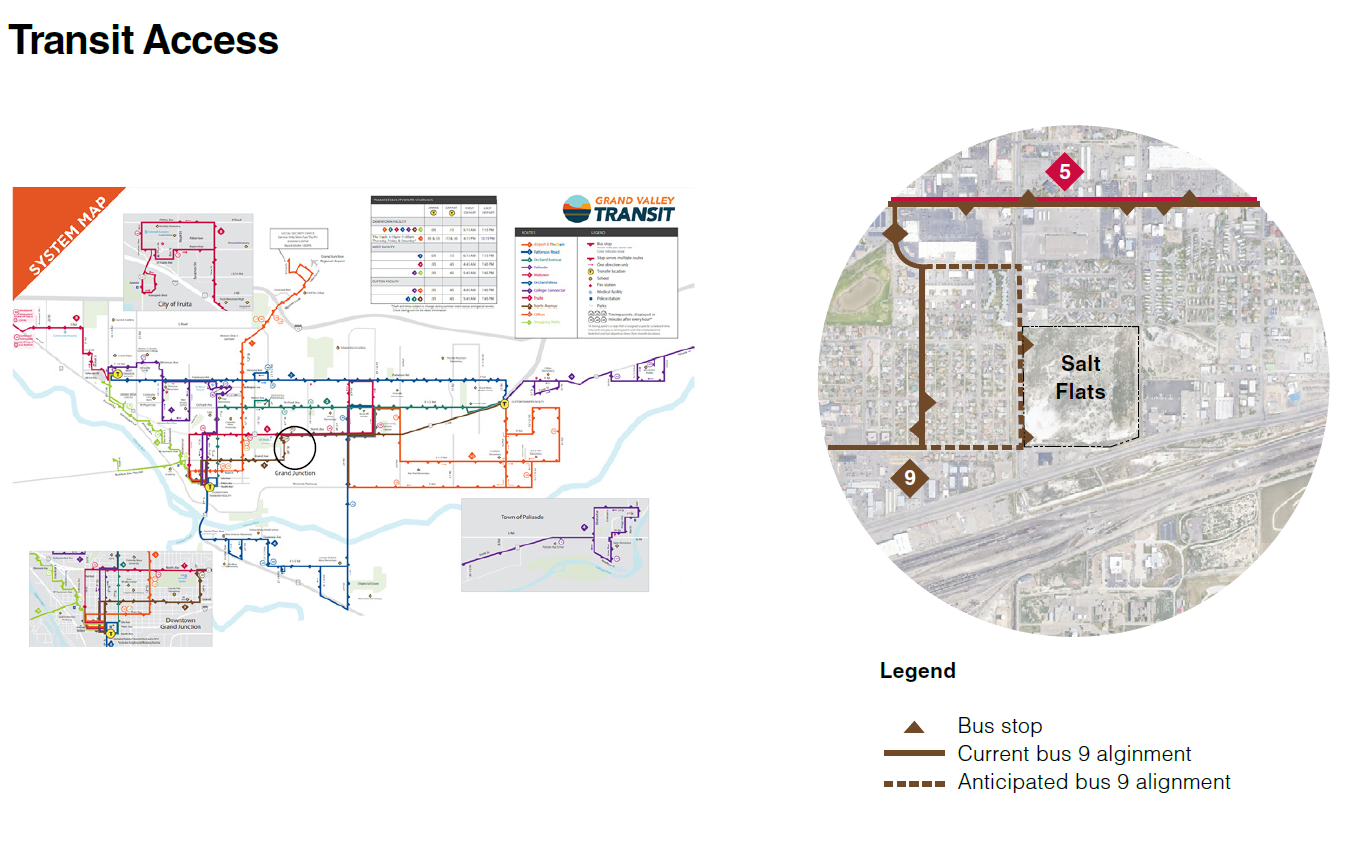
The master developer is currently working with Grand Valley Transit (GVT) on the potential to create two new bus stops within the Salt Flats site.
These transit connections would provide significant benefits for the new neighborhood. For the senior and veteran housing planned on the north end of the site, direct bus access would make it easier for residents to reach healthcare, shopping, and community services without relying on a car. For the broader community living throughout the site, the bus stops would connect households to jobs, schools, and amenities across Grand Junction.
By integrating public transit into the neighborhood design, Salt Flats will support mobility, independence, and accessibility for all residents while also reducing traffic impacts and strengthening links to the surrounding city.
-
Location & Site
Share Location & Site on Facebook Share Location & Site on X (formerly Twitter) Share Location & Site on Linkedin Email Location & Site linkLocation and Site
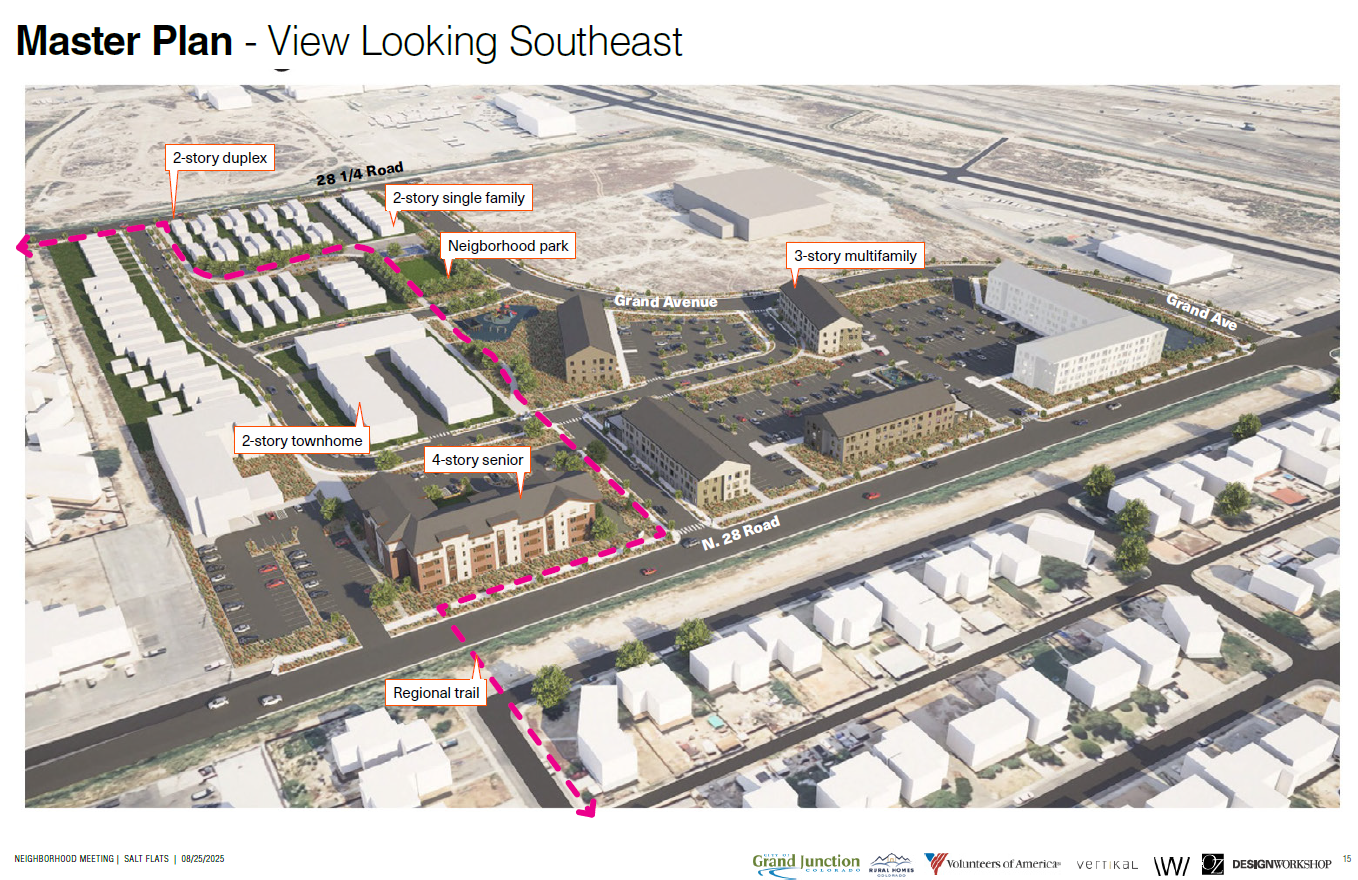
The Salt Flats project is located at 450 28 Road in Grand Junction, at the northeast corner of Grand Avenue and 28 Road. The property covers 21.78 acres and was once part of a larger tract of land. It is an infill opportunity within the City’s priority growth area.
The site was chosen because of its excellent location and connections. It sits near major employment corridors and is close to key community resources, including the Veteran’s Administration, local grocery stores, public schools, and the City’s new Recreation Center (now under construction). It is also just minutes from the downtown corridor, multiple parks, and regional sports complexes — making it an ideal place for new housing that connects people to jobs, services, and recreation.
The property is zoned RH-24 (Residential High, 24 units per acre) under the City’s 2020 Comprehensive Plan, which allows for high-density residential development, including multifamily housing. This zoning also supports the site as a transition between medium-density neighborhoods and nearby mixed-use or commercial areas.
Over the next decade, the Salt Flats development will be built in phases, creating a vibrant, mixed-income community. This site was selected because it aligns with Grand Junction’s commitment to inclusive growth, smart land use, and addressing critical housing needs in a central, well-connected location.
Site Due Diligence and Environmental Safety
Before moving forward with housing development, the City of Grand Junction completed extensive due diligence at the Salt Flats site to ensure it is a safe and suitable place for homes. “Due diligence” simply means taking all the proper steps — studies, tests, and investigations — to identify any potential risks before building.
Phase I Environmental Study
The first step was a Phase I Environmental Site Assessment. This study looks at the property’s history, public records, maps, and a site inspection to determine if there are any “recognized environmental conditions” (RECs), such as hazardous spills, petroleum leaks, or other contamination. The Salt Flats site was found to be in compliance, with no active hazards. A historical cleanup had already taken place decades ago, when over 52,000 cubic yards of uranium mill tailings were removed. In 1989, the Department of Energy certified the site as meeting federal safety standards.Grand Junction, like many communities in the West, has a history of uranium milling and mill tailings deposits. Through the federal Uranium Mill Tailings Remedial Action (UMTRA) Program, contaminated soils across the valley were identified, excavated, and hauled to permanent disposal sites. These efforts ensured that properties could be certified safe for reuse, protecting both residents and future development. The Salt Flats site is one of the many properties that went through this process and received federal clearance.
Groundwater Investigation
The City also collected and tested groundwater samples from monitoring wells across the property. The results found only very low levels of petroleum-related compounds, well below state safety standards. This confirmed there are no significant impacts to groundwater quality at the site.Gamma Radiation Survey
Because of Grand Junction’s history with uranium milling, the City conducted a surface gamma radiation survey. Using a grid system and sensitive detection equipment, experts walked the site to measure radiation levels. All readings were below background levels typical in Colorado, meaning there is no elevated radiation risk and the site is safe for housing.Geotechnical & Soil Studies
In addition, geotechnical investigations were carried out. These included drilling boreholes, analyzing soil samples, and monitoring groundwater depth to ensure the land can safely support new buildings, utilities, and roads. The studies confirmed that while the soils include clays, silts, and sandy layers, they are suitable for construction with standard engineering practices.ChatGPT said:
-
Who it serves
Share Who it serves on Facebook Share Who it serves on X (formerly Twitter) Share Who it serves on Linkedin Email Who it serves linkGrand Junction is facing a serious housing challenge. The City’s 2024 Housing Strategy shows that we need more homes for people at all income levels —from families looking to buy their first home, to seniors and workers needing affordable rental options.
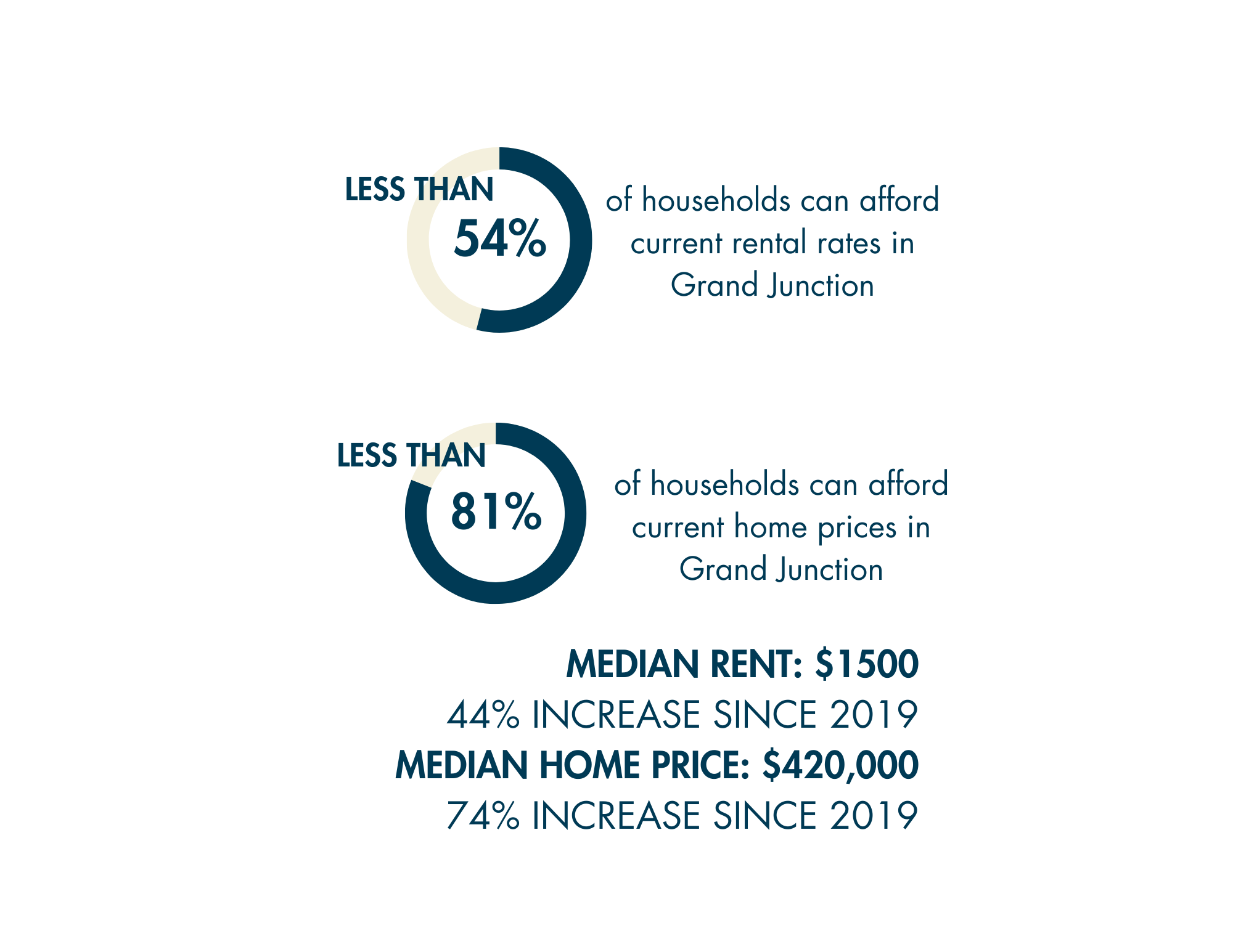
Over the past few years, housing costs have risen much faster than incomes. In 2019, many homes were still within reach for middle-income families. But by 2025, the median home price had climbed to $420,000 — a 74% increase in just six years. At the same time, higher interest rates have made it even harder for families to qualify for a mortgage. In 2021, nearly half of homes sold were affordable to moderate-income households; by 2024, that number had dropped to less than 1 in 10. Less than 81% of households can afford current home prices in Grand Junction.
The rental market tells a similar story. Since 2019, average rents have gone up by 44%, while household incomes have barely moved. Vacancy rates are at historic lows, and lower-cost rentals have nearly disappeared from the market. Many renters now pay close to a third of their income on housing, leaving little left over for savings or everyday expenses. Currently, less than 54% of households can afford current rental rates in Grand Junction
Altogether, we need more than 4,000 new homes in the coming years to keep up with demand — including both rentals and homes for sale. This includes a shortfall of about 2,700 moderately priced for-sale homes and more than 1,200 affordable rental units.
The Salt Flats Project is part of the solution. By building a mix of affordable, attainable, and market-rate housing, Salt Flats will help make sure Grand Junction remains a place where teachers, nurses, service workers, young professionals, and families of all sizes can find a home that works for them.
To utilize the State grants for infrastructure and land acquisition, the City of Grand Junction committed to ensuring the site is no less than 70% of units must meet the definition affordable housing. Click here to see the definition of affordable housing.
30% of the units can be attainable and market-rate housing, these units help to cross subsidize and get even lower rental and homeownership rates on other units.
Currently, the Salt Flats project is expected to deliver between 324 and 550 new homes.
Based on the proposals — which may change as financing, planning, and fire review processes move forward — here is a quick overview of the first phase of the housing units, along with their estimated price points and the households they are designed to serve:
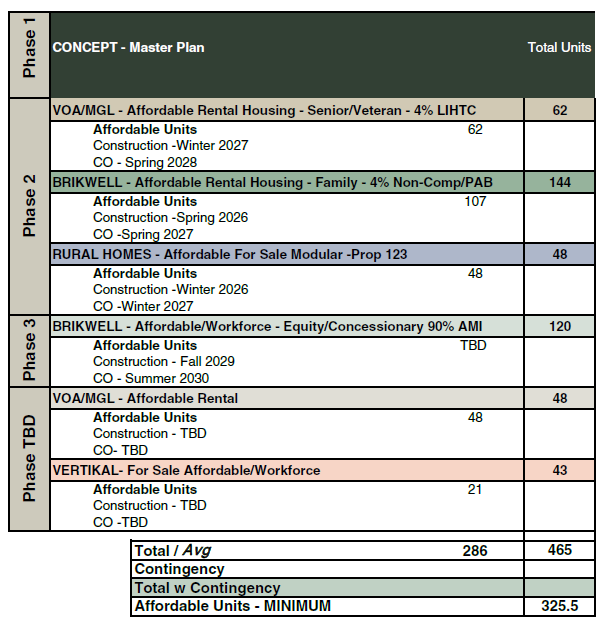
Volunteers of America/MGL - Affordable Rental Housing - 62 Units:
Construction is expected to begin in Winter 2027, with final completion in Spring 2028. The project will provide 62 new homes specifically for seniors and veterans, including 13 project-based vouchers for veterans. These homes will be reserved for households earning 60% of the Area Median Income (AMI) — which is about $50,000 for a two-person household. At this income level, the maximum allowable rent (including utilities) would be $1,377 for a two-bedroom or $1,147 for a one-bedroom. However, rents will ultimately be set so that no household pays more than 30% of their actual income, ensuring affordability tailored to each family’s situation.
Brikwell - The Ascent at Salt Flats - Affordable Rental Housing - 144 Units:
Construction is expected to begin in Spring 2026, with completion anticipated in Spring 2027. This project will bring 144 new homes for single individuals and families, offering a mix of studios, one-, two-, three-, and four-bedroom apartments. Brikwell plans to use an income averaging approach across the development at approximately 58% of the Area Median Income (AMI). This means some units will be set as low as 30% AMI and others as high as 70% AMI, creating a balance that allows for cross-subsidization within the project. For example, a studio at 30% AMI would have a maximum rent of about $535 per month, while a four-bedroom at the same income level would be capped around $888 per month.
Rural Homes - Affordable Homeownership - 48 Units:
Construction is expected to begin in Winter/Spring 2026, with completion anticipated in Winter/Spring 2027. This project will deliver 48 new for-sale townhomes designed for families. Rural Homes plans to use modular construction to build both townhomes and single-family homes affordable to households earning less than 100% of the Area Median Income (AMI).
This approach allows families to purchase homes at prices well below the general housing market. For example, a family of four earning 80% of AMI could purchase a home for approximately $262,000, or about $2,040 per month including utilities and insurance.
Detailed information on future phases COMING SOON!
A general estimate of future phases and units:
-
Affordability at the Salt Flats
Share Affordability at the Salt Flats on Facebook Share Affordability at the Salt Flats on X (formerly Twitter) Share Affordability at the Salt Flats on Linkedin Email Affordability at the Salt Flats linkAffordability at the Salt Flats
As part of the Proposition 123 Land Banking Grant, the Salt Flats project must meet strict affordability requirements. At least 70% of the homes built on the site must meet the definition of affordable, meaning they are priced within reach of households at specific income levels as defined by the U.S. Department of Housing and Urban Development. The remaining 30% of homes can be built as attainable or market-rate units, which helps offset costs and makes the overall project financially viable.
Attainable, or workforce housing, is designed for households that earn too much to qualify for traditional affordable housing programs but still struggle to find housing in today’s market. These are often nurses, police officers, firefighters, teachers, and skilled trade workers — people who are essential to our community but are increasingly priced out of Grand Junction’s housing market.
By blending affordable, attainable, and market-rate housing across the Salt Flats site, the project creates a neighborhood that reflects the real mix of incomes and families in Grand Junction. This variety is important not just for fairness, but also for the health of the community — ensuring that the people who work here, serve here, and raise their families here can also afford to live here.
What is Affordable Housing?
It’s important to know that housing affordability and affordable housing are not the same thing.
Housing affordability describes the general cost of housing in the market compared to what people earn. For example, when home prices or rents rise faster than wages, housing becomes less affordable for everyone.
Affordable housing, on the other hand, has a specific legal definition. These are homes that are intentionally created and protected to remain within reach for households at certain income levels.
Affordable housing is built with long-term protections and guidelines that make sure it truly serves the community members who need it most. To qualify as affordable housing, a unit must meet four key elements:
-
Income Restricted – Affordable housing is reserved for households within certain income limits, as set by the U.S. Department of Housing and Urban Development (HUD). For rental units, households must typically earn 60% or less of the Area Median Income (AMI). For homeownership opportunities, the maximum income is 100% of AMI.
AMI is adjusted by household size. For example, in Grand Junction a family of four could earn up to $61,200 to qualify for an affordable rental, or up to $102,000 to qualify for an affordable home purchase. With the average local wage at about $54,000, most working families in Grand Junction would meet these income requirements.
-
Price Restricted – Affordable housing must have a rent or sale price capped so that local families can realistically afford it. These price limits are tied to the Area Median Income (AMI) and set by the U.S. Department of Housing and Urban Development (HUD).
For rental housing, the maximum rent (including utilities) is capped at the 60% AMI level and adjusted by bedroom size. For example:
A studio apartment could not exceed $1,071/month
A two-bedroom apartment could not exceed $1,377/month
For homes for sale, affordability is calculated to ensure that monthly housing costs (mortgage, utilities, insurance, etc.) remain within reach. A household earning about $102,000 (100% AMI for a family of four) could afford a home priced around $325,000, or about $2,400/month with all costs included.
These limits ensure that affordable homes and apartments stay priced for the households that need them most.
3. Long-Term Affordability – Affordable housing isn’t just affordable when it’s first built — it’s required to stay affordable for the long term. Through legal agreements, these homes are guaranteed to remain affordable for 30 to 99 years, depending on the type of funding or program used.This ensures that affordable homes continue serving families well into the future, even as the housing market changes. Instead of rising to full market prices after a few years, these units stay within reach for working families, seniors, and future generations of Grand Junction residents.
4. Cost-Burden Standard – Affordable housing is designed so that households spend no more than 30% of their income on housing costs. This includes rent or mortgage payments, plus essential expenses like utilities and insurance.
This standard ensures families are not “cost-burdened,” meaning they still have enough income left for food, transportation, healthcare, and other daily needs.
For example, a household earning $54,000 per year (about the average in Grand Junction) should pay no more than $1,350 per month for housing and utilities. Affordable housing programs are built around this standard to make sure working families can live securely without being stretched too thin.
To see a full 2025 Income and Maximum Rental Table for Mesa County by AMI and bedrooms - click here.
To put it into perspective, affordable housing in Grand Junction serves a broad range of our community. For seniors, veterans, and minimum-wage earners at or below 30% AMI, these units provide stability. At 40% AMI, they support daycare workers, para-educators, and hospitality staff. At 60% AMI, they make housing possible for agricultural workers, EMTs, and those in sales and retail. At 80% AMI, they support firefighters, teachers, and social workers. And at 100% AMI, they provide options for nurses and police officers.
Affordable housing isn’t about “them” or “low-income” — it’s about creating homes for all members of our community who need to live, work, and thrive here, ensuring Grand Junction remains both safe and economically diverse.
Attainable/Workforce Housing
In Grand Junction, attainable or workforce housing is generally defined as:
Rental units affordable to households earning 60–80% of the Area Median Income (AMI).
Homeownership units affordable to households earning 100–120% of AMI.
To put this into perspective, most new market-rate rentals in Grand Junction are priced at about 85–90% AMI — out of reach for many working families. On the ownership side, the average home price is now around $420,000, and new construction typically costs even more.
Attainable housing fills the gap for households that earn too much to qualify for traditional affordable housing programs but still can’t keep up with market prices. This often includes teachers, nurses, police officers, firefighters, and skilled trades workers — people our community depends on every day.
By including attainable housing at Salt Flats, alongside affordable and market-rate homes, the project helps ensure that a full range of Grand Junction’s workforce has a place to call home.
Understanding Market-Rate vs. Affordable Housing
Most of the new rental housing built in Grand Junction over the past five years has been market-rate housing. Market-rate simply means the price of rent is set by what the market will bear, without any limits or protections to keep it affordable for local families. Developers and property owners set rents based on demand, construction costs, and what they believe people are willing to pay.
Because of this, market-rate housing is not the same as affordable housing. Affordable housing has income limits, rent caps, and long-term agreements to make sure it remains accessible to households at a range of incomes. Market-rate housing does not have these restrictions, which means rents often end up higher than what many working families can afford.
While new market-rate units do add supply to the community, they typically do not meet the needs of lower- and middle-income households. That’s why affordable housing is so important — to ensure that teachers, service workers, first responders, families, and seniors can all find a home within reach.