Housing
Welcome! We're glad you're here.
The City of Grand Junction Housing Division works to expand housing opportunities, support a variety of housing choices, and help ensure that Grand Junction remains a community where people of all ages, incomes, and backgrounds have the opportunity to live, work, and thrive.
While the City plays an active role in housing, the City does not build, own, or manage housing developments. Instead, we work alongside developers, nonprofit organizations, housing providers, businesses, local agencies, state and federal partners, and community members to help bring housing projects and programs to life. Through these partnerships, the City helps remove barriers, secure funding, coordinate infrastructure investments, develop housing policies, and support projects that increase housing opportunities throughout our community.
This Engage GJ page is your source for the latest information on the City's housing initiatives and the many housing projects we are supporting throughout Grand Junction. Instead of creating an annual report one time per year, we are hoping to provide regular updates on the City's partnerships with affordable and workforce housing developments, planning efforts, grant programs, public meetings, community engagement opportunities, policy initiatives, and other housing-related projects.
Our goal is to provide transparent, timely information about the work underway, explain how these projects benefit our community, and offer opportunities for residents to learn more and provide input along the way.
We encourage you to follow along, ask questions, and stay engaged as we work together with our community partners to address Grand Junction's housing needs.
Stay Connected
Don't forget to Follow this Project by clicking the Follow Project button in the right-hand sidebar. By subscribing, you'll receive notifications whenever new updates, project milestones, meeting announcements, or engagement opportunities are posted.
Thank you for your interest in the future of housing in Grand Junction—we're excited to keep you informed!
Important information to Check Out:
History of the Housing Division
Other Housing Project Pages:
Salt Flats Project - Salt Flats is a mixed-income housing development that will bring new affordable and attainable housing opportunities to Grand Junction. Follow the project's progress through construction updates, milestones, and development news.
Housing Needs Assessment & Housing Action Plan Project - assesses Grand Junction's long-term strategy for addressing local housing needs. Learn more about the planning process, review the draft documents, and stay informed as the plan moves toward City Council adoption. Once adopted, future implementation updates and progress will be posted on this page.
Welcome! We're glad you're here.
The City of Grand Junction Housing Division works to expand housing opportunities, support a variety of housing choices, and help ensure that Grand Junction remains a community where people of all ages, incomes, and backgrounds have the opportunity to live, work, and thrive.
While the City plays an active role in housing, the City does not build, own, or manage housing developments. Instead, we work alongside developers, nonprofit organizations, housing providers, businesses, local agencies, state and federal partners, and community members to help bring housing projects and programs to life. Through these partnerships, the City helps remove barriers, secure funding, coordinate infrastructure investments, develop housing policies, and support projects that increase housing opportunities throughout our community.
This Engage GJ page is your source for the latest information on the City's housing initiatives and the many housing projects we are supporting throughout Grand Junction. Instead of creating an annual report one time per year, we are hoping to provide regular updates on the City's partnerships with affordable and workforce housing developments, planning efforts, grant programs, public meetings, community engagement opportunities, policy initiatives, and other housing-related projects.
Our goal is to provide transparent, timely information about the work underway, explain how these projects benefit our community, and offer opportunities for residents to learn more and provide input along the way.
We encourage you to follow along, ask questions, and stay engaged as we work together with our community partners to address Grand Junction's housing needs.
Stay Connected
Don't forget to Follow this Project by clicking the Follow Project button in the right-hand sidebar. By subscribing, you'll receive notifications whenever new updates, project milestones, meeting announcements, or engagement opportunities are posted.
Thank you for your interest in the future of housing in Grand Junction—we're excited to keep you informed!
Important information to Check Out:
History of the Housing Division
Other Housing Project Pages:
Salt Flats Project - Salt Flats is a mixed-income housing development that will bring new affordable and attainable housing opportunities to Grand Junction. Follow the project's progress through construction updates, milestones, and development news.
Housing Needs Assessment & Housing Action Plan Project - assesses Grand Junction's long-term strategy for addressing local housing needs. Learn more about the planning process, review the draft documents, and stay informed as the plan moves toward City Council adoption. Once adopted, future implementation updates and progress will be posted on this page.
-
Project Highlight: Latimer House Expansion
Share Project Highlight: Latimer House Expansion on Facebook Share Project Highlight: Latimer House Expansion on X (formerly Twitter) Share Project Highlight: Latimer House Expansion on Linkedin Email Project Highlight: Latimer House Expansion link
Project Highlight: Hilltop Latimer House Expansion
Expanding Safe Housing for Survivors in Grand Junction
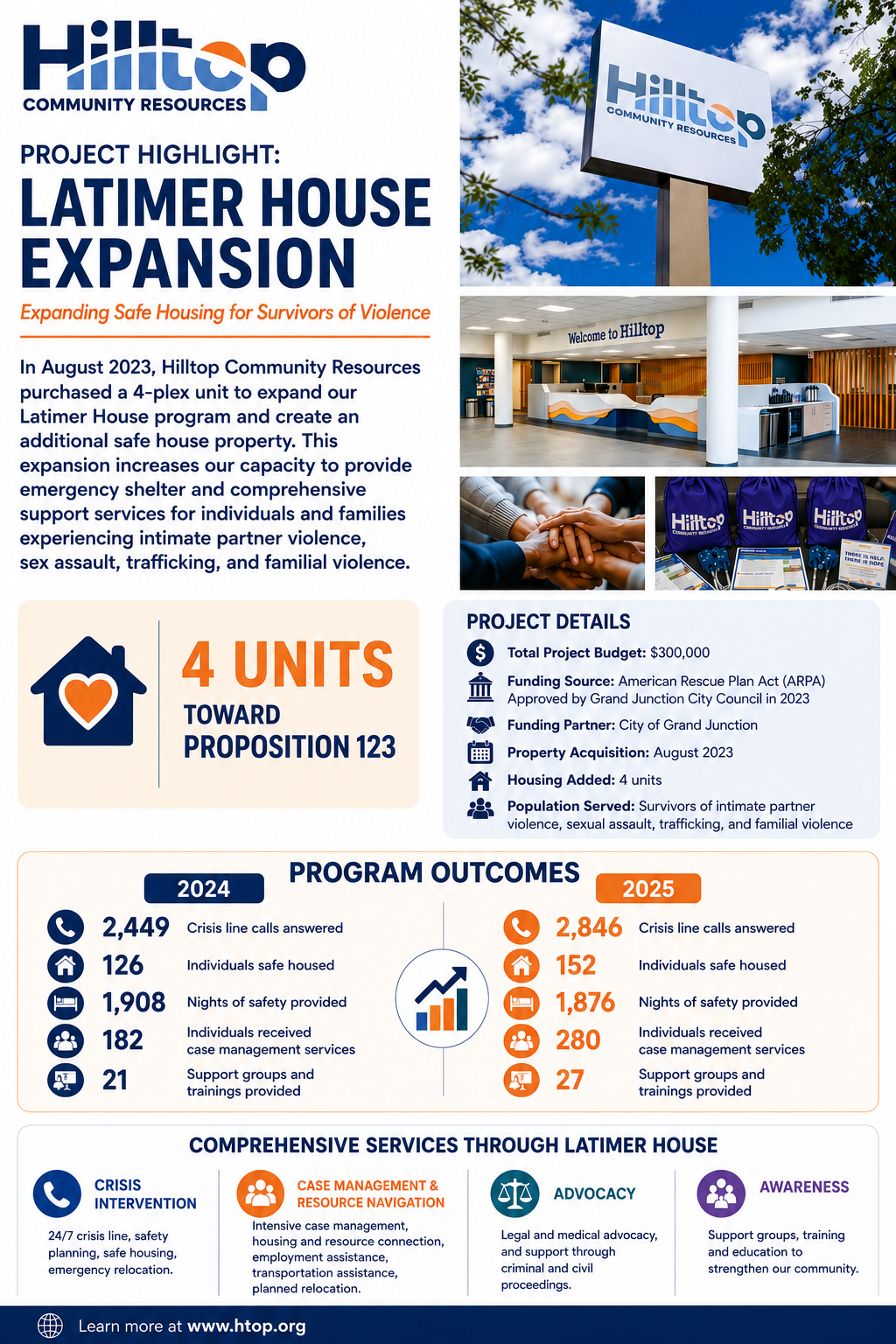
Hilltop’s Latimer House expansion provides additional safe, confidential housing for individuals and families escaping intimate partner violence, sexual assault, human trafficking, and familial violence. Through the purchase of a four-unit residential property, Hilltop expanded the capacity of the Latimer House program to meet growing community needs while providing survivors with a secure place to begin rebuilding their lives.
The property was purchased in August 2023 and includes four separate housing units that operate as part of Hilltop’s broader safe house program. Because resident safety and confidentiality are essential, the location and identifying details of the property are not publicly disclosed.
Each unit provides survivors with a stable and private living environment while they work with Hilltop staff to develop individualized plans for safety, housing stability, employment, financial independence, and long-term well-being. The expanded property allows the program to serve more households while offering the privacy and flexibility needed to support individuals and families with different circumstances.
A Partnership Investment
The Hilltop Latimer House expansion demonstrates how local partnerships can provide immediate and lasting benefits for some of the community’s most vulnerable residents.
City Council approved the use of American Rescue Plan Act (ARPA) funding for Hilltop to support the acquisition of the four-unit property and expand the community’s available safe housing. The total project budget was approximately $300,000.
The investment helped Hilltop:
- Purchase an additional residential property for the Latimer House program.
- Expand services for survivors of intimate partner violence, sexual assault, trafficking, and familial violence.
- Provide residents with greater stability while they transition toward permanent housing and independence.
- Strengthen the community’s broader network of emergency and supportive housing resources.
By investing in an existing residential property, Hilltop was able to expand program capacity efficiently while maintaining a setting that feels safe, private, and residential for participants.
Supporting Grand Junction’s Housing Goals
The four Latimer House units also supported the City of Grand Junction’s affordable housing production goals under Colorado Proposition 123. The units were counted toward the City’s Proposition 123 housing commitment in 2026, recognizing the important role that emergency and transitional housing plays within the community’s broader housing system.
These units provide more than temporary shelter. They create a critical bridge between crisis and long-term stability, giving survivors the time, privacy, and support needed to identify permanent housing and move forward safely.
The project also advances the City’s goal of supporting a range of housing options that respond to different levels of need, including emergency shelter, transitional housing, supportive services, affordable rental housing, and pathways to permanent housing.
Creating Safety and Stability
Residents of the Latimer House program receive more than a place to stay. Hilltop provides confidential, trauma-informed services designed to support each participant’s individual needs. Services may include safety planning, advocacy, case management, connections to legal and healthcare resources, housing navigation, employment support, and assistance accessing community programs.
The four-unit property allows individuals and families to remain together in a private setting while receiving support from experienced staff. This model helps reduce the disruption often experienced by survivors leaving unsafe situations and provides a stable foundation from which they can begin planning for the future.
A Lasting Community Impact
The Hilltop Latimer House expansion represents a targeted investment in safety, dignity, and long-term housing stability. By adding four confidential units to the community’s safe housing inventory, the project allows more survivors to access immediate protection while working toward permanent housing and greater independence.
The partnership between Hilltop and the City of Grand Junction demonstrates how relatively small, strategic housing investments can create meaningful and lasting community impact. The project strengthens the local response to domestic and interpersonal violence, supports the City’s Proposition 123 housing goals, and ensures that survivors have access to safe, quality housing when they need it most.

Project Highlight: Hilltop Latimer House Expansion
Expanding Safe Housing for Survivors in Grand Junction
Hilltop’s Latimer House expansion provides additional safe, confidential housing for individuals and families escaping intimate partner violence, sexual assault, human trafficking, and familial violence. Through the purchase of a four-unit residential property, Hilltop expanded the capacity of the Latimer House program to meet growing community needs while providing survivors with a secure place to begin rebuilding their lives.
The property was purchased in August 2023 and includes four separate housing units that operate as part of Hilltop’s broader safe house program. Because resident safety and confidentiality are essential, the location and identifying details of the property are not publicly disclosed.
Each unit provides survivors with a stable and private living environment while they work with Hilltop staff to develop individualized plans for safety, housing stability, employment, financial independence, and long-term well-being. The expanded property allows the program to serve more households while offering the privacy and flexibility needed to support individuals and families with different circumstances.
A Partnership Investment
The Hilltop Latimer House expansion demonstrates how local partnerships can provide immediate and lasting benefits for some of the community’s most vulnerable residents.
City Council approved the use of American Rescue Plan Act (ARPA) funding for Hilltop to support the acquisition of the four-unit property and expand the community’s available safe housing. The total project budget was approximately $300,000.
The investment helped Hilltop:
- Purchase an additional residential property for the Latimer House program.
- Expand services for survivors of intimate partner violence, sexual assault, trafficking, and familial violence.
- Provide residents with greater stability while they transition toward permanent housing and independence.
- Strengthen the community’s broader network of emergency and supportive housing resources.
By investing in an existing residential property, Hilltop was able to expand program capacity efficiently while maintaining a setting that feels safe, private, and residential for participants.
Supporting Grand Junction’s Housing Goals
The four Latimer House units also supported the City of Grand Junction’s affordable housing production goals under Colorado Proposition 123. The units were counted toward the City’s Proposition 123 housing commitment in 2026, recognizing the important role that emergency and transitional housing plays within the community’s broader housing system.
These units provide more than temporary shelter. They create a critical bridge between crisis and long-term stability, giving survivors the time, privacy, and support needed to identify permanent housing and move forward safely.
The project also advances the City’s goal of supporting a range of housing options that respond to different levels of need, including emergency shelter, transitional housing, supportive services, affordable rental housing, and pathways to permanent housing.
Creating Safety and Stability
Residents of the Latimer House program receive more than a place to stay. Hilltop provides confidential, trauma-informed services designed to support each participant’s individual needs. Services may include safety planning, advocacy, case management, connections to legal and healthcare resources, housing navigation, employment support, and assistance accessing community programs.
The four-unit property allows individuals and families to remain together in a private setting while receiving support from experienced staff. This model helps reduce the disruption often experienced by survivors leaving unsafe situations and provides a stable foundation from which they can begin planning for the future.
A Lasting Community Impact
The Hilltop Latimer House expansion represents a targeted investment in safety, dignity, and long-term housing stability. By adding four confidential units to the community’s safe housing inventory, the project allows more survivors to access immediate protection while working toward permanent housing and greater independence.
The partnership between Hilltop and the City of Grand Junction demonstrates how relatively small, strategic housing investments can create meaningful and lasting community impact. The project strengthens the local response to domestic and interpersonal violence, supports the City’s Proposition 123 housing goals, and ensures that survivors have access to safe, quality housing when they need it most.
-
Project Highlight: The Current with Grand Junction Housing Authority
Share Project Highlight: The Current with Grand Junction Housing Authority on Facebook Share Project Highlight: The Current with Grand Junction Housing Authority on X (formerly Twitter) Share Project Highlight: The Current with Grand Junction Housing Authority on Linkedin Email Project Highlight: The Current with Grand Junction Housing Authority link
The Current at ConfluenceCreating Affordable Housing Along the 24 Road Corridor
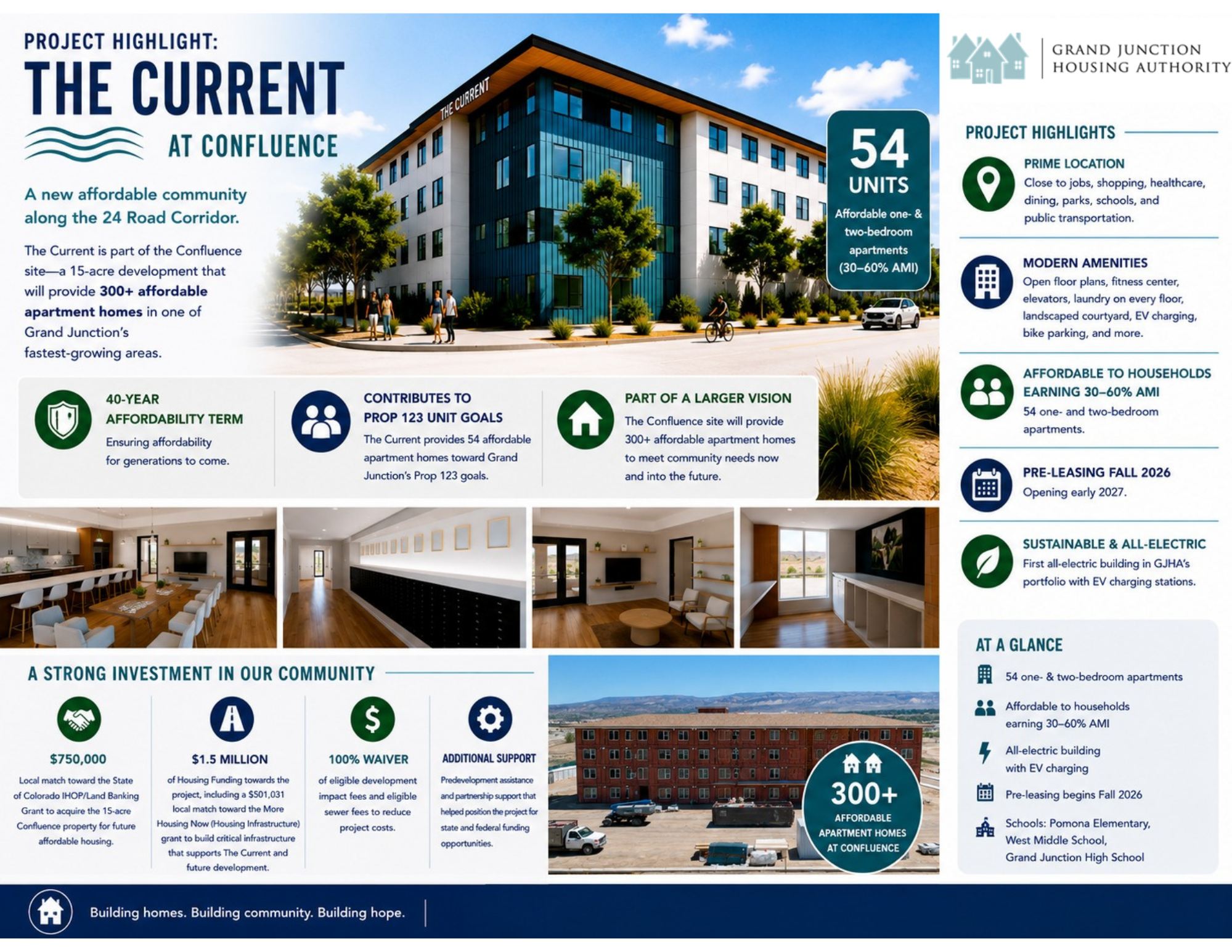
The Current is the first phase of the Grand Junction Housing Authority's (GJHA) Confluence development, a transformative affordable housing community that will ultimately bring more than 300 affordable apartment homes to a 15-acre site along the growing 24 Road Corridor. As the first of six planned phases, The Current represents an important investment in expanding housing opportunities while laying the foundation for future affordable housing development in one of Grand Junction's fastest-growing employment centers.
The four-story community will include 54 one- and two-bedroom apartments affordable to households earning between 30-60% AMI with a 40 year affordability period, ensuring these homes continue serving working families for decades to come.
Located near Community Hospital, Mesa Mall, grocery stores, childcare, restaurants, Canyon View Park, and public transportation, The Current provides residents with convenient access to employment, services, recreation, and everyday amenities in a highly walkable location. The community will feature modern amenities including open floor plans, elevators, a fitness center, landscaped courtyards, laundry facilities on every floor, bicycle parking, electric vehicle charging stations, and water, sewer, and trash included in rent.
A Partnership Investment
The Current demonstrates how strong local and state partnerships can leverage public investment to create long-term community benefit.
The City of Grand Junction has partnered closely with the Grand Junction Housing Authority and the State of Colorado to bring this project to fruition through a combination of land acquisition, infrastructure investments, fee reductions, and financial assistance.
City investments include:
- $750,000 local match toward the State of Colorado Innovative Housing Opportunity Program (IHOP)/Land Banking Grant, which enabled acquisition of the 15-acre Confluence property for future affordable housing development.
- $1.5 million of Housing Funding towards the project, including a $501,031 local match toward the More Housing Now (Housing Infrastructure) grant to construct critical public infrastructure including roads, sidewalks, utilities, drainage, irrigation, and multimodal improvements that will support not only The Current, but future phases of development.
- 100% waiver of eligible development Impact Fees and eligible Sewer Fees to reduce project costs.
- Additional predevelopment assistance and partnership support that helped position the project for state and federal funding opportunities.
Together, these investments helped leverage millions of dollars in additional funding, including Low-Income Housing Tax Credits (LIHTC), state affordable housing tax credits, Grand Junction Housing Authority equity, and other public and private funding sources.
Supporting Grand Junction's Housing Goals
The Current is also an important part of the City's commitment under Colorado Proposition 123. The project's 54 affordable apartments contribute toward Grand Junction's affordable housing production goals while expanding housing choices for households that otherwise face limited options in today's housing market.
Beyond the initial 54 apartments, the public infrastructure installed today will support future phases of the Confluence development, allowing the site to ultimately provide more than 300 affordable homes over time. This long-term investment helps maximize the value of public infrastructure while creating a lasting supply of affordable housing for future generations.
Coming Soon
Construction is currently underway, with pre-leasing anticipated to begin in Fall 2026. The community is expected to open in early 2027.
To be considered for housing at The Current, interested households must first apply to the Grand Junction Housing Authority's Affordable Rental Waiting List. Applicants must meet program income requirements, complete background screening, and rents are based on household size and gross income.
The Current is more than a new apartment community—it represents a long-term partnership and investment in Grand Junction's future, helping ensure that working families, seniors, and individuals have access to safe, quality, and affordable housing in a thriving neighborhood.
The Current at ConfluenceCreating Affordable Housing Along the 24 Road Corridor
The Current is the first phase of the Grand Junction Housing Authority's (GJHA) Confluence development, a transformative affordable housing community that will ultimately bring more than 300 affordable apartment homes to a 15-acre site along the growing 24 Road Corridor. As the first of six planned phases, The Current represents an important investment in expanding housing opportunities while laying the foundation for future affordable housing development in one of Grand Junction's fastest-growing employment centers.
The four-story community will include 54 one- and two-bedroom apartments affordable to households earning between 30-60% AMI with a 40 year affordability period, ensuring these homes continue serving working families for decades to come.
Located near Community Hospital, Mesa Mall, grocery stores, childcare, restaurants, Canyon View Park, and public transportation, The Current provides residents with convenient access to employment, services, recreation, and everyday amenities in a highly walkable location. The community will feature modern amenities including open floor plans, elevators, a fitness center, landscaped courtyards, laundry facilities on every floor, bicycle parking, electric vehicle charging stations, and water, sewer, and trash included in rent.
A Partnership Investment
The Current demonstrates how strong local and state partnerships can leverage public investment to create long-term community benefit.
The City of Grand Junction has partnered closely with the Grand Junction Housing Authority and the State of Colorado to bring this project to fruition through a combination of land acquisition, infrastructure investments, fee reductions, and financial assistance.
City investments include:
- $750,000 local match toward the State of Colorado Innovative Housing Opportunity Program (IHOP)/Land Banking Grant, which enabled acquisition of the 15-acre Confluence property for future affordable housing development.
- $1.5 million of Housing Funding towards the project, including a $501,031 local match toward the More Housing Now (Housing Infrastructure) grant to construct critical public infrastructure including roads, sidewalks, utilities, drainage, irrigation, and multimodal improvements that will support not only The Current, but future phases of development.
- 100% waiver of eligible development Impact Fees and eligible Sewer Fees to reduce project costs.
- Additional predevelopment assistance and partnership support that helped position the project for state and federal funding opportunities.
Together, these investments helped leverage millions of dollars in additional funding, including Low-Income Housing Tax Credits (LIHTC), state affordable housing tax credits, Grand Junction Housing Authority equity, and other public and private funding sources.
Supporting Grand Junction's Housing Goals
The Current is also an important part of the City's commitment under Colorado Proposition 123. The project's 54 affordable apartments contribute toward Grand Junction's affordable housing production goals while expanding housing choices for households that otherwise face limited options in today's housing market.
Beyond the initial 54 apartments, the public infrastructure installed today will support future phases of the Confluence development, allowing the site to ultimately provide more than 300 affordable homes over time. This long-term investment helps maximize the value of public infrastructure while creating a lasting supply of affordable housing for future generations.
Coming Soon
Construction is currently underway, with pre-leasing anticipated to begin in Fall 2026. The community is expected to open in early 2027.
To be considered for housing at The Current, interested households must first apply to the Grand Junction Housing Authority's Affordable Rental Waiting List. Applicants must meet program income requirements, complete background screening, and rents are based on household size and gross income.
The Current is more than a new apartment community—it represents a long-term partnership and investment in Grand Junction's future, helping ensure that working families, seniors, and individuals have access to safe, quality, and affordable housing in a thriving neighborhood.
-
What is Affordable Housing?
Share What is Affordable Housing? on Facebook Share What is Affordable Housing? on X (formerly Twitter) Share What is Affordable Housing? on Linkedin Email What is Affordable Housing? link
Understanding Housing Affordability, Affordable Housing, Attainable Housing, and Market-Rate Housing
Housing is one of the most frequently discussed topics in Grand Junction, but terms like housing affordability, affordable housing, attainable housing, and market-rate housing are often used interchangeably—even though they mean very different things. Understanding these differences helps explain why communities invest in a variety of housing types and why no single solution addresses every household's needs.
Housing Affordability: Something Everyone Needs
Housing affordability is a financial concept—not a type of housing.
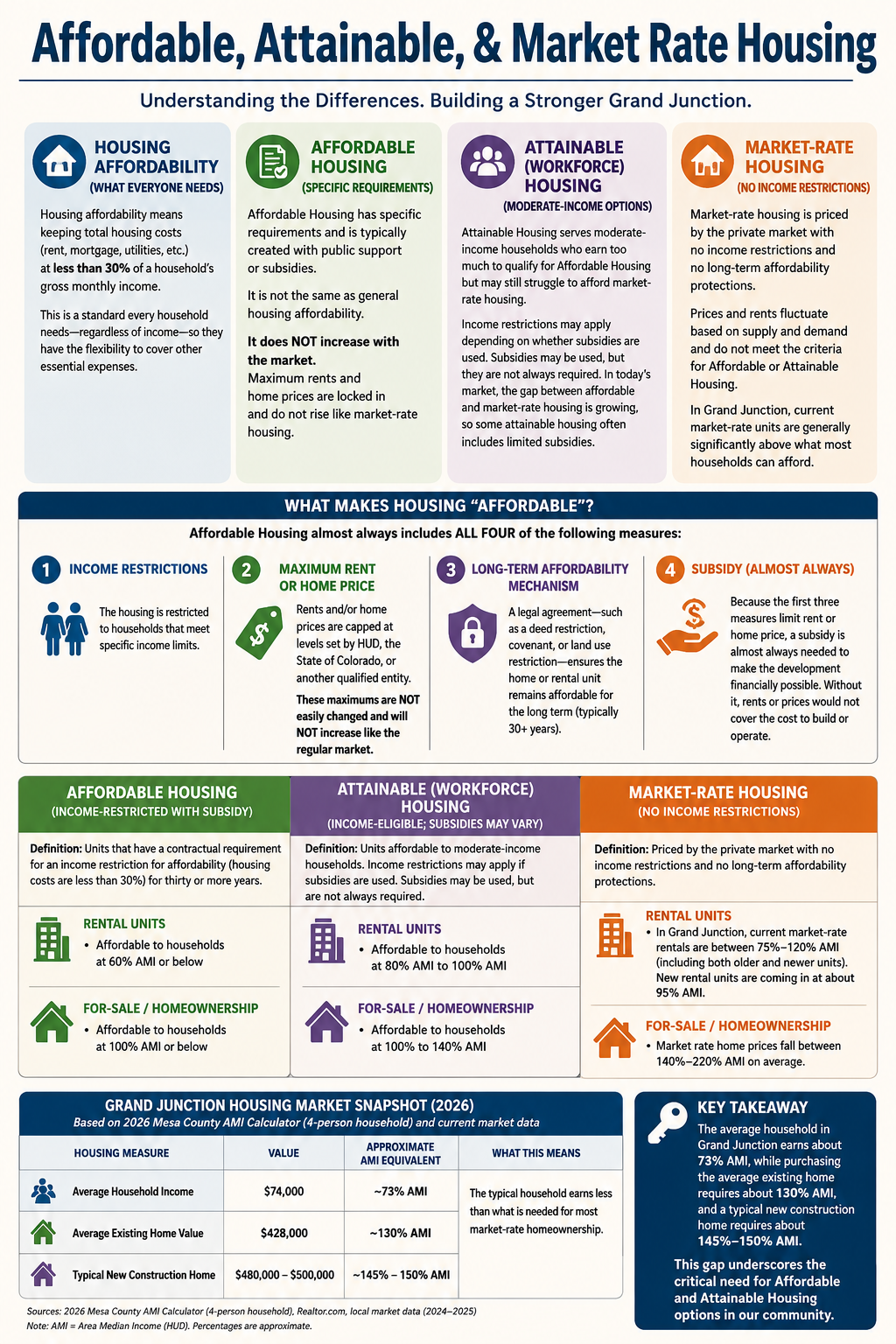
In general, housing is considered affordable when a household spends no more than 30% of its gross monthly income on housing costs, including rent or mortgage payments, insurance, taxes, utilities, and other required housing expenses.
This 30% guideline is used by the U.S. Department of Housing and Urban Development (HUD) because it allows households to have enough income remaining to pay for other necessities such as:
Food
Transportation
Childcare
Healthcare
Savings and emergencies
When households spend more than 30% of their income on housing, they are considered cost-burdened. Households spending more than 50% of their income on housing are considered severely cost-burdened, placing them at greater risk of financial hardship and housing instability.
Housing affordability is important for every household, regardless of income.
Affordable Housing
While everyone needs affordable housing costs, Affordable Housing (capitalized) refers to a specific type of housing with legally defined requirements.
Affordable housing is designed for lower-income households and almost always includes public investment because the housing cannot generally be built or operated using market rents or home prices alone.
Affordable housing typically includes four key characteristics:
1. Income Restrictions
Residents must meet established income limits to qualify.
These limits are typically based on Area Median Income (AMI) and are verified before occupancy.
2. Maximum Rent or Home Price
Affordable housing has maximum rents or sales prices established by HUD, the State of Colorado, or another funding agency.
Unlike market-rate housing, these rents and prices do not simply increase because the real estate market increases.
While annual adjustments may occur based on program rules or updated AMI calculations, the rent or sales price remains regulated to preserve affordability and cannot increase at normal market rates.
3. Long-Term Affordability
Affordable housing includes a legally binding affordability requirement such as:
Deed Restrictions
Covenants
Land Use Restriction Agreements (LURAs)
Other recorded affordability agreements
These legal mechanisms generally keep housing affordable for 30 years or longer, and in many cases permanently.
4. Public Subsidy
Because affordable housing has income limits, regulated rents or home prices, and long-term affordability requirements, the revenue generated by the project is often insufficient to cover the full cost of construction and financing.
For that reason, affordable housing almost always relies on one or more funding sources such as:
Low Income Housing Tax Credits (LIHTC)
State or federal grants
Local government assistance
Housing trust funds
Tax-exempt bonds
Housing Choice Vouchers
Other public or nonprofit financing
Without these funding sources, many affordable housing developments would not be financially feasible.
Attainable (Workforce) Housing
Attainable housing serves households that earn too much to qualify for many affordable housing programs but still cannot reasonably afford today's housing market.
Many attainable housing residents are the people who keep our community functioning, including:
Teachers
Police officers
Firefighters
Healthcare workers
Construction workers
Hospitality employees
Administrative staff
Service industry workers
Young professionals
First-time homebuyers
Unlike affordable housing, attainable housing may or may not include public subsidies.
Some attainable housing developments are built without government assistance. However, as the gap between development costs and market affordability continues to grow, many attainable housing developments now receive limited public support through incentives such as:
Impact fee reductions
Infrastructure assistance
Public land partnerships
Low-interest financing
Limited grants
Depending on the funding source, some attainable housing developments also include income restrictions, while others simply target moderate-income households through pricing.
Market-Rate Housing
Market-rate housing is housing whose price is determined entirely by supply and demand.
Unlike affordable or attainable housing, market-rate housing generally:
Has no income restrictions
Has no maximum rent or sales price
Has no long-term affordability requirements
Typically receives no public affordability subsidy
Because prices respond directly to the real estate market, rents and home prices increase (or decrease) as market conditions change.
Market-rate housing plays an important role in meeting overall housing demand, but it is not specifically designed to serve households with affordability challenges.
Current Market Conditions in Grand Junction
Current market data illustrates where market-rate housing generally falls today:
Rental Housing
Existing and newer market-rate apartments typically serve households earning approximately 75%–120% AMI.
Newly constructed apartment communities generally target households around 95% AMI.
Homeownership
Average existing home values generally require incomes around 130% AMI.
Typical new construction homes generally require incomes between 145% and 150% AMI, with many new homes falling within a broader market range of 140%–220% AMI.
What is Area Median Income (AMI)?
Area Median Income (AMI) is the midpoint of household incomes for a region and is calculated annually by the U.S. Department of Housing and Urban Development (HUD).
AMI is adjusted based on household size and serves as the standard used by most housing programs to determine eligibility and affordability.
Housing programs frequently reference percentages of AMI because they provide a consistent way to compare housing affordability across different income levels.
Grand Junction's Housing Definitions
In August 2023, the Grand Junction City Council adopted Resolution 65-23, establishing the City's definitions for Affordable and Attainable Housing.
Affordable Housing
Affordable Housing includes units with a contractual affordability requirement lasting 30 years or more.
Rental Housing
Affordable to households earning 60% AMI or below
Homeownership
Affordable to households earning 100% AMI or below
Attainable (Workforce) Housing
Rental Housing
Affordable to households earning approximately 80% to 100% AMI
Homeownership
Affordable to households earning approximately 100% to 140% AMI
Why Does This Matter?
One of the biggest challenges facing Grand Junction is the growing gap between what households earn and what housing costs.
Using current 2026 data:
Measure Approximate AMI Average Grand Junction household income ~73% AMI Average existing home ~130% AMI Typical newly constructed home ~145–150% AMI This means the average Grand Junction household earns significantly less than the income generally needed to purchase today's average home or a newly built home.
Closing that gap requires a balanced housing strategy that includes:
Preserving existing affordable housing
Building new affordable housing
Expanding attainable/workforce housing
Supporting market-rate housing production
Encouraging housing choices across all income levels
Together, these efforts help ensure Grand Junction remains a community where residents of all incomes can live, work, and thrive.

Understanding Housing Affordability, Affordable Housing, Attainable Housing, and Market-Rate Housing
Housing is one of the most frequently discussed topics in Grand Junction, but terms like housing affordability, affordable housing, attainable housing, and market-rate housing are often used interchangeably—even though they mean very different things. Understanding these differences helps explain why communities invest in a variety of housing types and why no single solution addresses every household's needs.
Housing Affordability: Something Everyone Needs
Housing affordability is a financial concept—not a type of housing.
In general, housing is considered affordable when a household spends no more than 30% of its gross monthly income on housing costs, including rent or mortgage payments, insurance, taxes, utilities, and other required housing expenses.
This 30% guideline is used by the U.S. Department of Housing and Urban Development (HUD) because it allows households to have enough income remaining to pay for other necessities such as:
Food
Transportation
Childcare
Healthcare
Savings and emergencies
When households spend more than 30% of their income on housing, they are considered cost-burdened. Households spending more than 50% of their income on housing are considered severely cost-burdened, placing them at greater risk of financial hardship and housing instability.
Housing affordability is important for every household, regardless of income.
Affordable Housing
While everyone needs affordable housing costs, Affordable Housing (capitalized) refers to a specific type of housing with legally defined requirements.
Affordable housing is designed for lower-income households and almost always includes public investment because the housing cannot generally be built or operated using market rents or home prices alone.
Affordable housing typically includes four key characteristics:
1. Income Restrictions
Residents must meet established income limits to qualify.
These limits are typically based on Area Median Income (AMI) and are verified before occupancy.
2. Maximum Rent or Home Price
Affordable housing has maximum rents or sales prices established by HUD, the State of Colorado, or another funding agency.
Unlike market-rate housing, these rents and prices do not simply increase because the real estate market increases.
While annual adjustments may occur based on program rules or updated AMI calculations, the rent or sales price remains regulated to preserve affordability and cannot increase at normal market rates.
3. Long-Term Affordability
Affordable housing includes a legally binding affordability requirement such as:
Deed Restrictions
Covenants
Land Use Restriction Agreements (LURAs)
Other recorded affordability agreements
These legal mechanisms generally keep housing affordable for 30 years or longer, and in many cases permanently.
4. Public Subsidy
Because affordable housing has income limits, regulated rents or home prices, and long-term affordability requirements, the revenue generated by the project is often insufficient to cover the full cost of construction and financing.
For that reason, affordable housing almost always relies on one or more funding sources such as:
Low Income Housing Tax Credits (LIHTC)
State or federal grants
Local government assistance
Housing trust funds
Tax-exempt bonds
Housing Choice Vouchers
Other public or nonprofit financing
Without these funding sources, many affordable housing developments would not be financially feasible.
Attainable (Workforce) Housing
Attainable housing serves households that earn too much to qualify for many affordable housing programs but still cannot reasonably afford today's housing market.
Many attainable housing residents are the people who keep our community functioning, including:
Teachers
Police officers
Firefighters
Healthcare workers
Construction workers
Hospitality employees
Administrative staff
Service industry workers
Young professionals
First-time homebuyers
Unlike affordable housing, attainable housing may or may not include public subsidies.
Some attainable housing developments are built without government assistance. However, as the gap between development costs and market affordability continues to grow, many attainable housing developments now receive limited public support through incentives such as:
Impact fee reductions
Infrastructure assistance
Public land partnerships
Low-interest financing
Limited grants
Depending on the funding source, some attainable housing developments also include income restrictions, while others simply target moderate-income households through pricing.
Market-Rate Housing
Market-rate housing is housing whose price is determined entirely by supply and demand.
Unlike affordable or attainable housing, market-rate housing generally:
Has no income restrictions
Has no maximum rent or sales price
Has no long-term affordability requirements
Typically receives no public affordability subsidy
Because prices respond directly to the real estate market, rents and home prices increase (or decrease) as market conditions change.
Market-rate housing plays an important role in meeting overall housing demand, but it is not specifically designed to serve households with affordability challenges.
Current Market Conditions in Grand Junction
Current market data illustrates where market-rate housing generally falls today:
Rental Housing
Existing and newer market-rate apartments typically serve households earning approximately 75%–120% AMI.
Newly constructed apartment communities generally target households around 95% AMI.
Homeownership
Average existing home values generally require incomes around 130% AMI.
Typical new construction homes generally require incomes between 145% and 150% AMI, with many new homes falling within a broader market range of 140%–220% AMI.
What is Area Median Income (AMI)?
Area Median Income (AMI) is the midpoint of household incomes for a region and is calculated annually by the U.S. Department of Housing and Urban Development (HUD).
AMI is adjusted based on household size and serves as the standard used by most housing programs to determine eligibility and affordability.
Housing programs frequently reference percentages of AMI because they provide a consistent way to compare housing affordability across different income levels.
Grand Junction's Housing Definitions
In August 2023, the Grand Junction City Council adopted Resolution 65-23, establishing the City's definitions for Affordable and Attainable Housing.
Affordable Housing
Affordable Housing includes units with a contractual affordability requirement lasting 30 years or more.
Rental Housing
Affordable to households earning 60% AMI or below
Homeownership
Affordable to households earning 100% AMI or below
Attainable (Workforce) Housing
Rental Housing
Affordable to households earning approximately 80% to 100% AMI
Homeownership
Affordable to households earning approximately 100% to 140% AMI
Why Does This Matter?
One of the biggest challenges facing Grand Junction is the growing gap between what households earn and what housing costs.
Using current 2026 data:
Measure Approximate AMI Average Grand Junction household income ~73% AMI Average existing home ~130% AMI Typical newly constructed home ~145–150% AMI This means the average Grand Junction household earns significantly less than the income generally needed to purchase today's average home or a newly built home.
Closing that gap requires a balanced housing strategy that includes:
Preserving existing affordable housing
Building new affordable housing
Expanding attainable/workforce housing
Supporting market-rate housing production
Encouraging housing choices across all income levels
Together, these efforts help ensure Grand Junction remains a community where residents of all incomes can live, work, and thrive.
-
Prop 123: Regional Collaboration July 2026 Update (2023-2026 Cycle)
Share Prop 123: Regional Collaboration July 2026 Update (2023-2026 Cycle) on Facebook Share Prop 123: Regional Collaboration July 2026 Update (2023-2026 Cycle) on X (formerly Twitter) Share Prop 123: Regional Collaboration July 2026 Update (2023-2026 Cycle) on Linkedin Email Prop 123: Regional Collaboration July 2026 Update (2023-2026 Cycle) linkRegional Proposition 123 Intergovernmental Agreement (IGA)
Working Together to Increase Housing Opportunities
In 2022, Colorado voters approved Proposition 123, creating an ongoing statewide affordable housing fund that invests approximately $300 million annually into housing programs across Colorado. The funding supports affordable rental housing, attainable homeownership, infrastructure, land acquisition, preservation, and other housing initiatives. (cdola.colorado.gov)
To remain eligible for these funding opportunities, local governments voluntarily adopt a three-year housing commitment. Recognizing that housing production occurs at different rates throughout Mesa County, the City of Grand Junction, Mesa County, the Town of Palisade, and the City of Fruita developed a Regional Intergovernmental Agreement (IGA). Each entity approved it through their formal hearing process in May and June 2026.
The Regional IGA allows participating jurisdictions to work collaboratively toward their combined housing commitments by sharing eligible housing unit credits when appropriate. The agreement does not change local zoning authority, land use decisions, or development approvals. Instead, it helps ensure communities and affordable housing projects throughout the region remain eligible to compete for Proposition 123 funding opportunities. (trim22-web.gjcity.org)
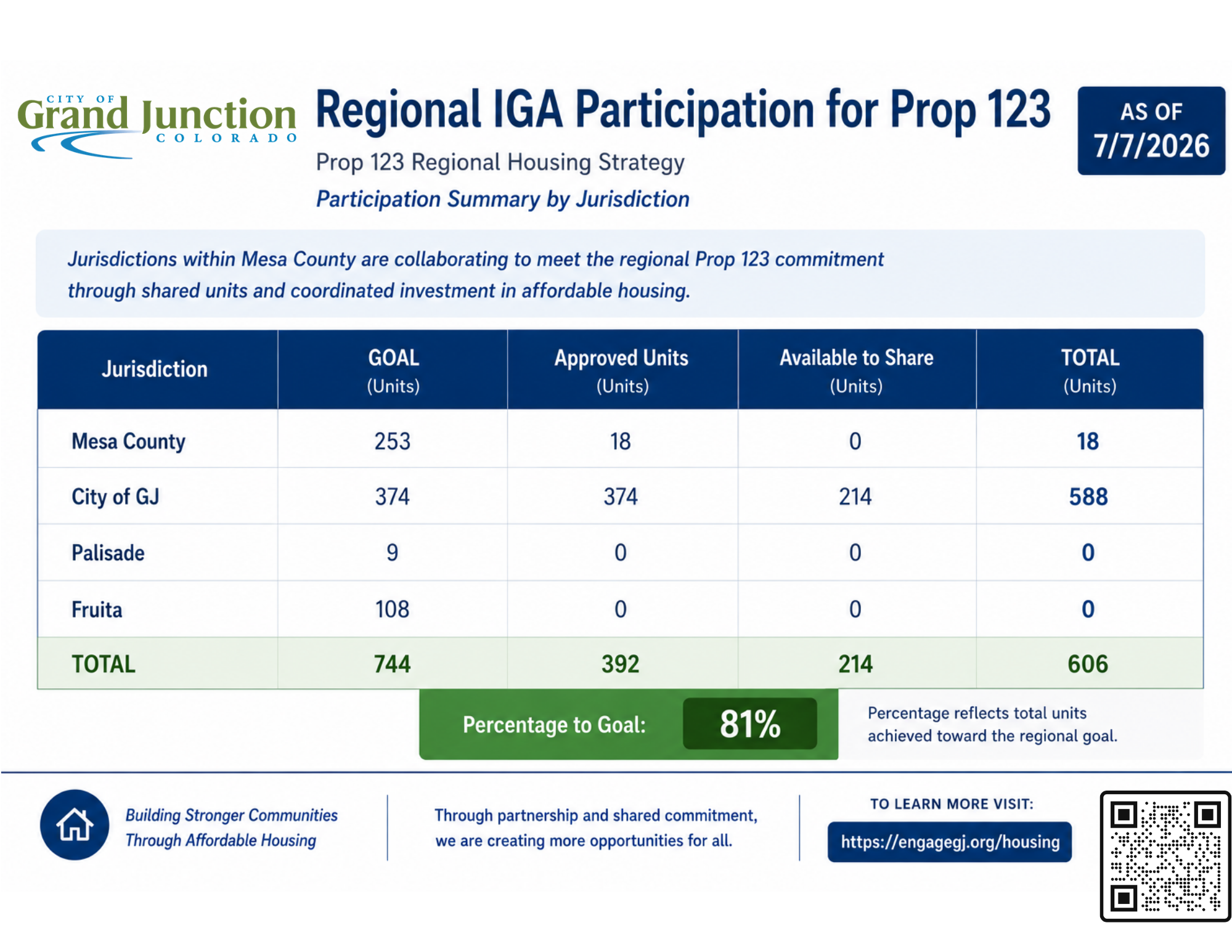
In April 2026, the City of Grand Junction successfully met its Proposition 123 Housing Commitment, becoming one of the first communities in Colorado to achieve its required housing production goal. As additional qualifying housing units continued to be approved, the City accumulated more units than were needed to satisfy its commitment. Through the Regional Proposition 123 Intergovernmental Agreement (IGA), Grand Junction can share these excess qualifying units with Mesa County, the Town of Palisade, and the City of Fruita. This regional collaboration helps participating jurisdictions—and the affordable housing projects within their communities—remain eligible to compete for Proposition 123 funding opportunities during the 2027 funding cycle while continuing to support affordable housing development throughout Mesa County.
Looking Ahead
The Regional IGA positions Mesa County communities to work together as housing projects advance over the coming years. As additional developments receive permits, begin construction, and complete qualifying milestones, more housing units will be submitted to the State and regional progress will continue to grow.
The collaboration helps ensure that communities throughout Mesa County remain eligible to compete for Proposition 123 funding while creating more affordable housing opportunities for current and future residents.
Regional Proposition 123 Intergovernmental Agreement (IGA)
Working Together to Increase Housing Opportunities
In 2022, Colorado voters approved Proposition 123, creating an ongoing statewide affordable housing fund that invests approximately $300 million annually into housing programs across Colorado. The funding supports affordable rental housing, attainable homeownership, infrastructure, land acquisition, preservation, and other housing initiatives. (cdola.colorado.gov)
To remain eligible for these funding opportunities, local governments voluntarily adopt a three-year housing commitment. Recognizing that housing production occurs at different rates throughout Mesa County, the City of Grand Junction, Mesa County, the Town of Palisade, and the City of Fruita developed a Regional Intergovernmental Agreement (IGA). Each entity approved it through their formal hearing process in May and June 2026.
The Regional IGA allows participating jurisdictions to work collaboratively toward their combined housing commitments by sharing eligible housing unit credits when appropriate. The agreement does not change local zoning authority, land use decisions, or development approvals. Instead, it helps ensure communities and affordable housing projects throughout the region remain eligible to compete for Proposition 123 funding opportunities. (trim22-web.gjcity.org)
In April 2026, the City of Grand Junction successfully met its Proposition 123 Housing Commitment, becoming one of the first communities in Colorado to achieve its required housing production goal. As additional qualifying housing units continued to be approved, the City accumulated more units than were needed to satisfy its commitment. Through the Regional Proposition 123 Intergovernmental Agreement (IGA), Grand Junction can share these excess qualifying units with Mesa County, the Town of Palisade, and the City of Fruita. This regional collaboration helps participating jurisdictions—and the affordable housing projects within their communities—remain eligible to compete for Proposition 123 funding opportunities during the 2027 funding cycle while continuing to support affordable housing development throughout Mesa County.

Looking Ahead
The Regional IGA positions Mesa County communities to work together as housing projects advance over the coming years. As additional developments receive permits, begin construction, and complete qualifying milestones, more housing units will be submitted to the State and regional progress will continue to grow.
The collaboration helps ensure that communities throughout Mesa County remain eligible to compete for Proposition 123 funding while creating more affordable housing opportunities for current and future residents.
-
What is Prop 123?
Share What is Prop 123? on Facebook Share What is Prop 123? on X (formerly Twitter) Share What is Prop 123? on Linkedin Email What is Prop 123? linkWhat is Proposition 123?
In November 2022, Colorado voters approved Proposition 123, which dedicates a portion of state income tax revenue to support affordable housing across Colorado. The program is administered by:
CHFA (Colorado Housing and Finance Authority) and OEDIT (Office of Economic Development & International Trade) through the Colorado Affordable Housing Financing Fund (CAHFF), and
DOLA (Department of Local Affairs) through the Affordable Housing Support Fund.
How Can Communities Use It?
Prop 123 offers the opportunity for jurisdictions (and those projects WITHIN their jurisdiction) who have opted in to compete for funding tools for cities, nonprofits, and housing authorities, who have opted in to the commitment including:
Land Banking Grants/Loans – to purchase and hold land for affordable housing (Grand Junction used this tool to acquire the Salt Flats site with a $2.2M grant).
Concessionary Debt & Equity – lower-cost financing options to make projects feasible.
Homeownership Programs – down payment assistance and affordable mortgage products for local families.
Expedited Review Requirement – participating jurisdictions must streamline approvals for affordable housing projects to save time and cost.
What Did Grand Junction Commit To?
By opting in, the City committed to:
Growing affordable housing by 3% each year (per state guidelines).
Adopting expedited review procedures for affordable housing projects.
Using Prop 123 tools to help local developers and nonprofits reduce costs and unlock more housing opportunities.
Opportunities for Our Community
Unlocks Outside Dollars: Rather than relying only on local taxes, Prop 123 allows Grand Junction to bring in statewide funding to lower costs for housing.
Land Banking = Feasibility: High land and infrastructure costs often stop projects before they start. Land banking grants make it possible to secure sites like Salt Flats for housing.
Supports Local Families: Homes built with Prop 123 are income-restricted, ensuring they remain affordable for teachers, nurses, firefighters, veterans, service workers, and seniors.
Stability for Developers: Flexible financing tools and predictable state support make projects more likely to succeed.
Community Investment: Affordable Housing Projects bring upgraded infrastructure, sidewalks, bike lanes, and potential parks, which benefit the entire neighborhood.
Challenges & Considerations
3% Growth Target: Every participating community must increase affordable housing by 3% annually, which may be challenging in smaller cities or during slow building years.
Competitive Funding: Prop 123 funds are in high demand across Colorado — not every project will be awarded dollars. There is limited funds and more requests from other jurisdictions and projects.
Administrative Burden: The reporting and compliance requirements add work for local governments, especially without a dedicated housing funding source to support staff and due diligence (like environmental reports or geotechnical studies).
Market Pressures: High construction costs, limited labor, and rising interest rates can still make projects difficult, even with Prop 123 support.
Why It Matters
Despite challenges, Prop 123 is a powerful opportunity. It gives Grand Junction the tools to reduce barriers, bring in new state funding, and partner with private developers and nonprofits to build housing that reflects the needs of our community.
By combining local leadership, state resources, and private investment, Prop 123 helps unlock housing that keeps our workforce, seniors, and families rooted in Grand Junction.
Want to Learn More?
Colorado Affordable Housing Financing Fund (CHFA & OEDIT): https://coloradoaffordablehousingfinancingfund.com
DOLA – Affordable Housing Programs: https://cdola.colorado.gov/prop-123
CHFA – Colorado Housing and Finance Authority: https://www.chfainfo.com
What is Proposition 123?
In November 2022, Colorado voters approved Proposition 123, which dedicates a portion of state income tax revenue to support affordable housing across Colorado. The program is administered by:
CHFA (Colorado Housing and Finance Authority) and OEDIT (Office of Economic Development & International Trade) through the Colorado Affordable Housing Financing Fund (CAHFF), and
DOLA (Department of Local Affairs) through the Affordable Housing Support Fund.
How Can Communities Use It?
Prop 123 offers the opportunity for jurisdictions (and those projects WITHIN their jurisdiction) who have opted in to compete for funding tools for cities, nonprofits, and housing authorities, who have opted in to the commitment including:
Land Banking Grants/Loans – to purchase and hold land for affordable housing (Grand Junction used this tool to acquire the Salt Flats site with a $2.2M grant).
Concessionary Debt & Equity – lower-cost financing options to make projects feasible.
Homeownership Programs – down payment assistance and affordable mortgage products for local families.
Expedited Review Requirement – participating jurisdictions must streamline approvals for affordable housing projects to save time and cost.
What Did Grand Junction Commit To?
By opting in, the City committed to:
Growing affordable housing by 3% each year (per state guidelines).
Adopting expedited review procedures for affordable housing projects.
Using Prop 123 tools to help local developers and nonprofits reduce costs and unlock more housing opportunities.
Opportunities for Our Community
Unlocks Outside Dollars: Rather than relying only on local taxes, Prop 123 allows Grand Junction to bring in statewide funding to lower costs for housing.
Land Banking = Feasibility: High land and infrastructure costs often stop projects before they start. Land banking grants make it possible to secure sites like Salt Flats for housing.
Supports Local Families: Homes built with Prop 123 are income-restricted, ensuring they remain affordable for teachers, nurses, firefighters, veterans, service workers, and seniors.
Stability for Developers: Flexible financing tools and predictable state support make projects more likely to succeed.
Community Investment: Affordable Housing Projects bring upgraded infrastructure, sidewalks, bike lanes, and potential parks, which benefit the entire neighborhood.
Challenges & Considerations
3% Growth Target: Every participating community must increase affordable housing by 3% annually, which may be challenging in smaller cities or during slow building years.
Competitive Funding: Prop 123 funds are in high demand across Colorado — not every project will be awarded dollars. There is limited funds and more requests from other jurisdictions and projects.
Administrative Burden: The reporting and compliance requirements add work for local governments, especially without a dedicated housing funding source to support staff and due diligence (like environmental reports or geotechnical studies).
Market Pressures: High construction costs, limited labor, and rising interest rates can still make projects difficult, even with Prop 123 support.
Why It Matters
Despite challenges, Prop 123 is a powerful opportunity. It gives Grand Junction the tools to reduce barriers, bring in new state funding, and partner with private developers and nonprofits to build housing that reflects the needs of our community.
By combining local leadership, state resources, and private investment, Prop 123 helps unlock housing that keeps our workforce, seniors, and families rooted in Grand Junction.
Want to Learn More?
Colorado Affordable Housing Financing Fund (CHFA & OEDIT): https://coloradoaffordablehousingfinancingfund.com
DOLA – Affordable Housing Programs: https://cdola.colorado.gov/prop-123
CHFA – Colorado Housing and Finance Authority: https://www.chfainfo.com
-
Prop 123: July 2026 Update
Share Prop 123: July 2026 Update on Facebook Share Prop 123: July 2026 Update on X (formerly Twitter) Share Prop 123: July 2026 Update on Linkedin Email Prop 123: July 2026 Update linkProposition 123: Expanding Affordable Housing Opportunities in Grand Junction (2024-2026 Cycle)
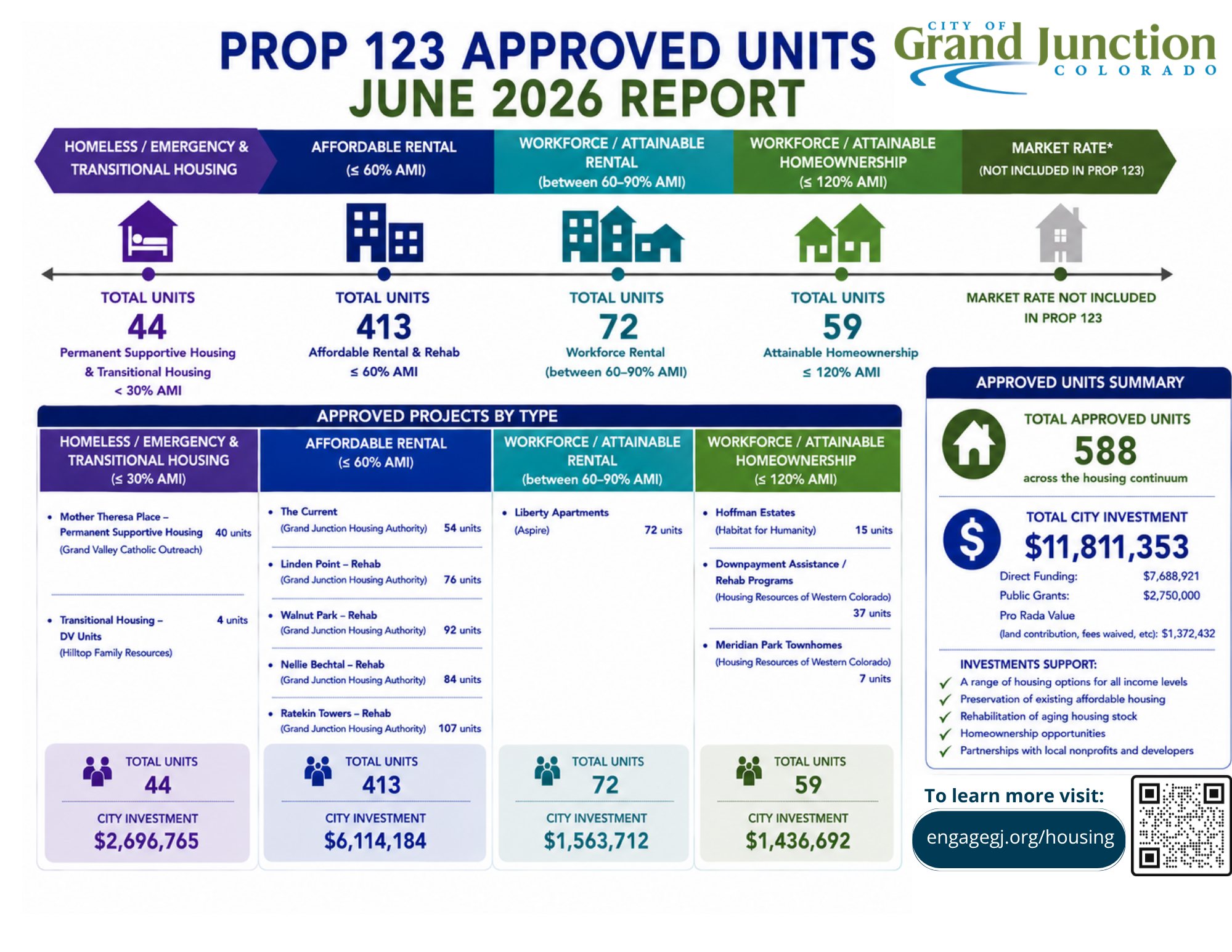
Proposition 123 July 2026 Update: Grand Junction Reaches 588 Approved Housing Units
As of July 8, 2026, the City of Grand Junction has received State approval for 588 qualifying Proposition 123 housing units—214 more units than required to fulfill its original Housing Commitment.
The City met its initial commitment in April 2026 after the State confirmed Grand Junction had successfully documented the required 374 qualifying affordable housing units. Since then, the City has continued working with local housing providers, nonprofit organizations, developers, and homeowners to submit additional qualifying units as projects reach eligible milestones.
Today, that total has grown to 588 approved units, and additional housing units will continue to be submitted as projects move through development.
What is Proposition 123?
Colorado voters approved Proposition 123 in November 2022, creating the State Affordable Housing Fund—a permanent statewide funding source dedicated to increasing affordable housing throughout Colorado.
Funded through 0.1% of state income tax revenues, Proposition 123 provides approximately $300 million annually to support housing initiatives administered by the Colorado Department of Local Affairs (DOLA) and the Colorado Housing and Finance Authority (CHFA).
Communities voluntarily participate by adopting a Housing Commitment to increase their affordable housing supply. In return, affordable housing projects within participating communities become eligible to compete for Proposition 123 funding.
Eligible funding can support:
- Affordable rental housing
- Affordable homeownership
- Infrastructure supporting housing development
- Land acquisition and land banking
- Preservation of affordable housing
- Down payment assistance
- Rental assistance
- Other innovative local housing solutions
Learn more about Proposition 123 (link).
Why Grand Junction Participates
The City voluntarily joined Proposition 123 because it aligns with Grand Junction's long-term housing goals while opening the door to significant state investment in local housing projects.
Participation supports implementation of the City's:
- Housing Needs Assessment
- Housing Action Plan
- Affordable housing partnerships with local developers and nonprofit organizations
Since Proposition 123 was approved, housing projects in Grand Junction have already secured more than $26 million in Proposition 123 funding, helping advance affordable rental housing, homeownership opportunities, and supportive housing throughout the community.
How Housing Units Are Counted
Proposition 123 does not require housing to be complete before it can count toward a community's commitment.
Instead, the State allows communities to submit qualifying housing units as projects reach specific development milestones, including:
- Building permit issuance
- Beginning vertical construction
- Sale of a qualifying affordable home
- Certificate of Occupancy
- Other qualifying milestones established by the State
Because of this process, many of the units counted toward Grand Junction's commitment are currently under construction and are expected to become available over the next one to two years.
Grand Junction's Progress
In August 2023, Grand Junction committed to increasing its affordable housing supply by 374 qualifying housing units during the initial Proposition 123 commitment period.
The City achieved that goal in April 2026, when the State officially confirmed the commitment had been met.
Since then, housing production has continued.
Current Status (July 8, 2026)
- Original Housing Commitment: 374 qualifying units
- State-Approved Qualifying Units: 588
- Units Above Commitment: 214
As additional housing developments receive building permits, begin vertical construction, or complete other qualifying milestones, the City will continue submitting eligible housing units to the State.
Looking Ahead: Regional Collaboration
Although Grand Junction has already fulfilled its original Housing Commitment, qualifying housing units continue to be generated through ongoing development across the community.
Under recent updates to Proposition 123, communities may participate in regional collaborations that allow qualifying housing units beyond a jurisdiction's commitment to help support other participating communities through approved intergovernmental agreements.
In May 2026, the City Council approved an Intergovernmental Agreement establishing a regional partnership between the City of Grand Junction, Mesa County, the Town of Fruita, and the Town of Palisade. This collaboration allows participating jurisdictions to work together in meeting regional housing goals while maintaining eligibility for Proposition 123 funding.
Learn more about the Regional Collaboration (link) Scheduled to be posted on 7/12/2026.
Organizations Contributing to Grand Junction's Housing Commitment
The following organizations have contributed—or are anticipated to contribute—qualifying housing units toward Grand Junction's Proposition 123 Housing Commitment. Housing units are counted as projects reach eligible State milestones, meaning many of these developments are still under construction or in active development.
Organization Project Qualifying Units* Primary Households Served Grand Junction Housing Authority Rehab** -
Linden Point, Walnut Park, Nellie Bechtal, Ratekin Towers - Projects Completed359 Primarily households earning between 30%-60% AMI, with some units up to 80% AMI Grand Junction Housing Authority New Construction - The Current
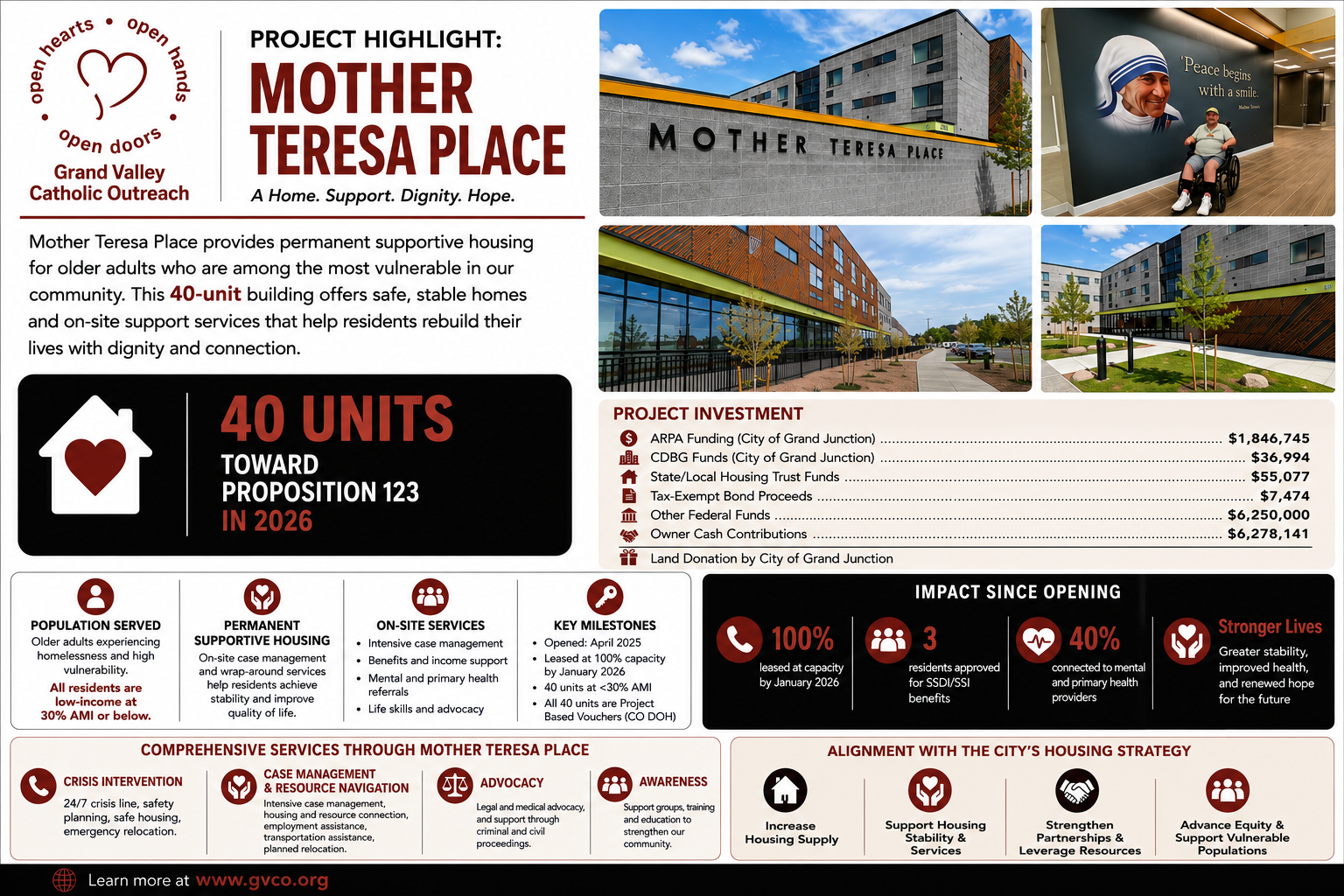
Currently In Construction - Estimated Completion: Spring 202754 Primarily households earning between 30%-60% AMI, with some units up to 80% AMI Grand Valley Catholic Outreach New Construction - Mother Teresa Place Permanent Supportive Housing - Completed 2025 40 Individuals experiencing homelessness; supportive housing (generally 30% AMI or below) Housing Resources of Western Colorado Rehab* Homeownership & Rehabilitation Programs 37 Homebuyers generally up to 80–120% AMI (program dependent) Housing Resources of Western Colorado New Construction - Meridian Park Townhomes - Project Completed in 2026, units are currently for sale 7 Homebuyers between 80-120% AMI Aspire Residential New Construction - Liberty Apartments - Under Construction - Estimated Completion in 2027 72 Affordable/workforce rental housing (anticipated 60-90% AMI) Habitat for Humanity of Mesa County New Construction - Affordable Homeownership - Estimated Completion - 2026 15 Homebuyers generally 30–80% AMI Hilltop Community Resources Preservation Units** -Permanent Supportive Housing - Completed in 2024 4 Domestic Violence Victims (generally 80% AMI or below) **Rehabilitation & Preservation Projects: These homes are already built and serving residents, but require significant reinvestment to remain safe, functional, and affordable. Improvements may include major rehabilitation such as roof replacement, building system upgrades, or substantial unit renovations. Preservation projects may also include units that were on the general housing market that were purchased for affordable housing, and had a deed restriction placed on them to remain affordable. Proposition 123 recognizes these investments by allowing qualifying affordable housing units to be counted as preservation, helping ensure they continue serving the households that rely on them for years to come.
Learn More About the Projects
The City is currently developing individual project updates for each housing development and program contributing toward Grand Junction's Proposition 123 Housing Commitment. These project pages will highlight development progress, construction milestones, funding partnerships, timelines, and anticipated completion dates as information becomes available.
To stay informed, follow this Engage GJ project page by selecting the "Follow Project" button on the right side of the page. Subscribers will receive updates as new project information, milestones, and housing announcements are posted.
Many of these developments remain under construction and will continue adding new homes over the next several years as projects move toward completion.
Proposition 123: Expanding Affordable Housing Opportunities in Grand Junction (2024-2026 Cycle)

Proposition 123 July 2026 Update: Grand Junction Reaches 588 Approved Housing Units
As of July 8, 2026, the City of Grand Junction has received State approval for 588 qualifying Proposition 123 housing units—214 more units than required to fulfill its original Housing Commitment.
The City met its initial commitment in April 2026 after the State confirmed Grand Junction had successfully documented the required 374 qualifying affordable housing units. Since then, the City has continued working with local housing providers, nonprofit organizations, developers, and homeowners to submit additional qualifying units as projects reach eligible milestones.
Today, that total has grown to 588 approved units, and additional housing units will continue to be submitted as projects move through development.
What is Proposition 123?
Colorado voters approved Proposition 123 in November 2022, creating the State Affordable Housing Fund—a permanent statewide funding source dedicated to increasing affordable housing throughout Colorado.
Funded through 0.1% of state income tax revenues, Proposition 123 provides approximately $300 million annually to support housing initiatives administered by the Colorado Department of Local Affairs (DOLA) and the Colorado Housing and Finance Authority (CHFA).
Communities voluntarily participate by adopting a Housing Commitment to increase their affordable housing supply. In return, affordable housing projects within participating communities become eligible to compete for Proposition 123 funding.
Eligible funding can support:
- Affordable rental housing
- Affordable homeownership
- Infrastructure supporting housing development
- Land acquisition and land banking
- Preservation of affordable housing
- Down payment assistance
- Rental assistance
- Other innovative local housing solutions
Learn more about Proposition 123 (link).
Why Grand Junction Participates
The City voluntarily joined Proposition 123 because it aligns with Grand Junction's long-term housing goals while opening the door to significant state investment in local housing projects.
Participation supports implementation of the City's:
- Housing Needs Assessment
- Housing Action Plan
- Affordable housing partnerships with local developers and nonprofit organizations
Since Proposition 123 was approved, housing projects in Grand Junction have already secured more than $26 million in Proposition 123 funding, helping advance affordable rental housing, homeownership opportunities, and supportive housing throughout the community.
How Housing Units Are Counted
Proposition 123 does not require housing to be complete before it can count toward a community's commitment.
Instead, the State allows communities to submit qualifying housing units as projects reach specific development milestones, including:
- Building permit issuance
- Beginning vertical construction
- Sale of a qualifying affordable home
- Certificate of Occupancy
- Other qualifying milestones established by the State
Because of this process, many of the units counted toward Grand Junction's commitment are currently under construction and are expected to become available over the next one to two years.
Grand Junction's Progress
In August 2023, Grand Junction committed to increasing its affordable housing supply by 374 qualifying housing units during the initial Proposition 123 commitment period.
The City achieved that goal in April 2026, when the State officially confirmed the commitment had been met.
Since then, housing production has continued.
Current Status (July 8, 2026)
- Original Housing Commitment: 374 qualifying units
- State-Approved Qualifying Units: 588
- Units Above Commitment: 214
As additional housing developments receive building permits, begin vertical construction, or complete other qualifying milestones, the City will continue submitting eligible housing units to the State.
Looking Ahead: Regional Collaboration
Although Grand Junction has already fulfilled its original Housing Commitment, qualifying housing units continue to be generated through ongoing development across the community.
Under recent updates to Proposition 123, communities may participate in regional collaborations that allow qualifying housing units beyond a jurisdiction's commitment to help support other participating communities through approved intergovernmental agreements.
In May 2026, the City Council approved an Intergovernmental Agreement establishing a regional partnership between the City of Grand Junction, Mesa County, the Town of Fruita, and the Town of Palisade. This collaboration allows participating jurisdictions to work together in meeting regional housing goals while maintaining eligibility for Proposition 123 funding.
Learn more about the Regional Collaboration (link) Scheduled to be posted on 7/12/2026.
Organizations Contributing to Grand Junction's Housing Commitment
The following organizations have contributed—or are anticipated to contribute—qualifying housing units toward Grand Junction's Proposition 123 Housing Commitment. Housing units are counted as projects reach eligible State milestones, meaning many of these developments are still under construction or in active development.
Organization Project Qualifying Units* Primary Households Served Grand Junction Housing Authority Rehab** -
Linden Point, Walnut Park, Nellie Bechtal, Ratekin Towers - Projects Completed359 Primarily households earning between 30%-60% AMI, with some units up to 80% AMI Grand Junction Housing Authority New Construction - The Current
Currently In Construction - Estimated Completion: Spring 202754 Primarily households earning between 30%-60% AMI, with some units up to 80% AMI Grand Valley Catholic Outreach New Construction - Mother Teresa Place Permanent Supportive Housing - Completed 2025 40 Individuals experiencing homelessness; supportive housing (generally 30% AMI or below) Housing Resources of Western Colorado Rehab* Homeownership & Rehabilitation Programs 37 Homebuyers generally up to 80–120% AMI (program dependent) Housing Resources of Western Colorado New Construction - Meridian Park Townhomes - Project Completed in 2026, units are currently for sale 7 Homebuyers between 80-120% AMI Aspire Residential New Construction - Liberty Apartments - Under Construction - Estimated Completion in 2027 72 Affordable/workforce rental housing (anticipated 60-90% AMI) Habitat for Humanity of Mesa County New Construction - Affordable Homeownership - Estimated Completion - 2026 15 Homebuyers generally 30–80% AMI Hilltop Community Resources Preservation Units** -Permanent Supportive Housing - Completed in 2024 4 Domestic Violence Victims (generally 80% AMI or below) **Rehabilitation & Preservation Projects: These homes are already built and serving residents, but require significant reinvestment to remain safe, functional, and affordable. Improvements may include major rehabilitation such as roof replacement, building system upgrades, or substantial unit renovations. Preservation projects may also include units that were on the general housing market that were purchased for affordable housing, and had a deed restriction placed on them to remain affordable. Proposition 123 recognizes these investments by allowing qualifying affordable housing units to be counted as preservation, helping ensure they continue serving the households that rely on them for years to come.
Learn More About the Projects
The City is currently developing individual project updates for each housing development and program contributing toward Grand Junction's Proposition 123 Housing Commitment. These project pages will highlight development progress, construction milestones, funding partnerships, timelines, and anticipated completion dates as information becomes available.
To stay informed, follow this Engage GJ project page by selecting the "Follow Project" button on the right side of the page. Subscribers will receive updates as new project information, milestones, and housing announcements are posted.
Many of these developments remain under construction and will continue adding new homes over the next several years as projects move toward completion.
-
History of the Housing Division
Share History of the Housing Division on Facebook Share History of the Housing Division on X (formerly Twitter) Share History of the Housing Division on Linkedin Email History of the Housing Division linkHistory of the Housing Division
The City of Grand Junction Housing Division was established to help address the community's evolving housing needs through strategic planning, partnerships, and innovative housing programs. Rather than constructing or managing housing directly, the Housing Division works alongside nonprofit organizations, housing authorities, private developers, government agencies, and community partners to expand housing opportunities for residents across the housing continuum.
The Housing Division serves as the City's lead for affordable housing policy, strategic planning, grant administration, housing development partnerships, homelessness initiatives, and public engagement. Its work is guided by data, community input, and collaboration to increase housing choice, improve housing affordability, and support a healthy and resilient community.
Today, the Housing Division oversees a wide range of initiatives, including:
Affordable Housing Incentive Program
Accessory Dwelling Unit (ADU) Production Program
Proposition 123 implementation
Salt Flats redevelopment
Housing Needs Assessment and Housing Action Plan
HUD Community Development Block Grant (CDBG) Program
2026–2030 Consolidated Plan and Annual Action Plan
At Home in GJ landlord partnership program
Rent Smart education
Almost Home Guide
Homelessness planning and regional coordination
Public engagement through Engage GJ
Housing & Houselessness as a City Priority
Grand Junction's 2020 Comprehensive Plan serves as a blueprint for the city, with it's foundation resting on the community's vision for the future. This vision provides guidance for the formulation of goals, strategies, and overall development in Grand Junction including housing and services for the unhoused specifically under Comprehensive Plan Principle 5: Strong Neighborhoods and Housing Choice. The Strategic Outcomes, updated every two years, integrates the priorities identified as most crucial by City Council into the broader framework of city planning and development. Housing and unhoused services were identified in the 2023-2025 City Council Strategic Outcome: Welcoming, Livable, Engaging to ensure that our community fosters a sense of belonging, where people are accepted as themselves and have access to the amenities, services they need to thrive, and actively seeks participation from our community.
Building a Housing Strategy
Grand Valley Housing Needs Assessment & Housing Strategy (2019–2022)
In 2019, the City partnered with Root Policy Research, Mesa County, local housing providers, and community stakeholders to complete the Grand Valley Housing Needs Assessment. The assessment provided the first comprehensive look at local housing conditions, demographic trends, housing affordability, development barriers, and future housing needs throughout the Grand Valley.
The findings informed the City's first comprehensive Housing Strategy, which was adopted by City Council on October 6, 2021, through Resolution 82-21. The strategy established twelve housing strategies focused on expanding housing opportunities, supporting affordable and workforce housing, strengthening partnerships, and reducing barriers to housing development.
Recognizing the importance of ongoing public education, City Council adopted Resolution 96-22 on December 21, 2022, adding a thirteenth strategy focused on community engagement and housing education.
Learn more:
Housing Strategy Update (2024)
As the Housing Strategy approached the midpoint of implementation, the City completed a comprehensive evaluation to measure progress and determine where adjustments were needed.
Housing tools, state legislation, funding opportunities, and market conditions have changed significantly since the original strategy was adopted in 2021. To ensure the City's housing efforts remain effective, the Housing Division again partnered with Root Policy Research to evaluate housing data, review implementation progress, and gather feedback from housing professionals and community partners.
Based on this work, City Council adopted Resolution 74-24 on October 16, 2024, updating the Housing Strategy with eleven refined strategies that build upon previous accomplishments while introducing new approaches to meeting the community's housing needs.
Many of the updated strategies continue successful initiatives already underway, while others respond to changing housing market conditions, new funding opportunities, and evolving community priorities.
Learn more:
Housing Needs Assessment & Housing Action Plan (2025–2026)
The Housing Division is currently leading development of a new Housing Needs Assessment (HNA) and Housing Action Plan (HAP) to guide the City's housing policies over the coming years.
Working with Root Policy Research, Mesa County, housing providers, developers, employers, nonprofit organizations, and residents, the City is conducting one of the most comprehensive housing planning efforts ever completed in the Grand Valley.
The planning process includes:
A regional housing market analysis
Demographic and economic trends
Housing affordability analysis
Housing production and development trends
Community and stakeholder surveys
Focus groups representing diverse community perspectives
Public meetings and community engagement
Recommendations for future housing policy and investment
The Housing Needs Assessment provides the data and analysis needed to understand current and future housing needs, while the Housing Action Plan identifies specific strategies, implementation actions, and priorities that will guide the City's work over the next several years.
Once adopted, the Housing Action Plan will serve as the City's primary housing policy document and help inform future decisions related to housing investments, land use, affordable housing programs, state funding opportunities, and implementation of Proposition 123.
Current Status: The Housing Needs Assessment and Housing Action Plan are currently underway, with adoption anticipated following public review and City Council consideration.
Learn more on the Engage GJ Project Page for the Housing Needs Assessment & Housing Action Plan
Unhoused Strategy & Implementation Plan
Housing stability extends beyond housing production. Recognizing the need for a coordinated community response to homelessness, the City partnered with local service providers and stakeholders to develop a community-wide Unhoused Strategy & Implementation Plan.
Building upon research completed through the Unhoused Needs Assessment (UHNA), the strategy identifies actions to address service gaps, strengthen coordination among providers, improve outreach, expand housing resources, and move the community toward the goal of achieving Functional Zero—where homelessness is rare, brief, and non-recurring. It is not intended to be a plan that the City alone is implementing, rather a list or priority actions that the entire community is working towards.
The plan was formally adopted by City Council on July 3, 2024, through Resolution 49-24.
The Housing Division continues to coordinate implementation with nonprofit organizations, behavioral health providers, housing agencies, Mesa County, law enforcement, and regional partners.
Learn more:
Continuing the Work
The Housing Division continues to evolve as new opportunities, funding sources, and partnerships emerge. By combining data-driven planning, strategic investment, public engagement, and regional collaboration, the Division is helping expand housing opportunities throughout Grand Junction.
Whether supporting affordable homeownership, encouraging new rental housing, preserving existing affordable homes, coordinating homelessness initiatives, or leveraging state and federal resources, the Housing Division remains committed to creating a community where residents at every stage of life have access to safe, attainable, and diverse housing options.
To learn more about current initiatives, explore the project pages throughout this site, or click "Follow Project" to receive updates as new information becomes available.
History of the Housing Division
The City of Grand Junction Housing Division was established to help address the community's evolving housing needs through strategic planning, partnerships, and innovative housing programs. Rather than constructing or managing housing directly, the Housing Division works alongside nonprofit organizations, housing authorities, private developers, government agencies, and community partners to expand housing opportunities for residents across the housing continuum.
The Housing Division serves as the City's lead for affordable housing policy, strategic planning, grant administration, housing development partnerships, homelessness initiatives, and public engagement. Its work is guided by data, community input, and collaboration to increase housing choice, improve housing affordability, and support a healthy and resilient community.
Today, the Housing Division oversees a wide range of initiatives, including:
Affordable Housing Incentive Program
Accessory Dwelling Unit (ADU) Production Program
Proposition 123 implementation
Salt Flats redevelopment
Housing Needs Assessment and Housing Action Plan
HUD Community Development Block Grant (CDBG) Program
2026–2030 Consolidated Plan and Annual Action Plan
At Home in GJ landlord partnership program
Rent Smart education
Almost Home Guide
Homelessness planning and regional coordination
Public engagement through Engage GJ
Housing & Houselessness as a City Priority
Grand Junction's 2020 Comprehensive Plan serves as a blueprint for the city, with it's foundation resting on the community's vision for the future. This vision provides guidance for the formulation of goals, strategies, and overall development in Grand Junction including housing and services for the unhoused specifically under Comprehensive Plan Principle 5: Strong Neighborhoods and Housing Choice. The Strategic Outcomes, updated every two years, integrates the priorities identified as most crucial by City Council into the broader framework of city planning and development. Housing and unhoused services were identified in the 2023-2025 City Council Strategic Outcome: Welcoming, Livable, Engaging to ensure that our community fosters a sense of belonging, where people are accepted as themselves and have access to the amenities, services they need to thrive, and actively seeks participation from our community.
Building a Housing Strategy
Grand Valley Housing Needs Assessment & Housing Strategy (2019–2022)
In 2019, the City partnered with Root Policy Research, Mesa County, local housing providers, and community stakeholders to complete the Grand Valley Housing Needs Assessment. The assessment provided the first comprehensive look at local housing conditions, demographic trends, housing affordability, development barriers, and future housing needs throughout the Grand Valley.
The findings informed the City's first comprehensive Housing Strategy, which was adopted by City Council on October 6, 2021, through Resolution 82-21. The strategy established twelve housing strategies focused on expanding housing opportunities, supporting affordable and workforce housing, strengthening partnerships, and reducing barriers to housing development.
Recognizing the importance of ongoing public education, City Council adopted Resolution 96-22 on December 21, 2022, adding a thirteenth strategy focused on community engagement and housing education.
Learn more:
Housing Strategy Update (2024)
As the Housing Strategy approached the midpoint of implementation, the City completed a comprehensive evaluation to measure progress and determine where adjustments were needed.
Housing tools, state legislation, funding opportunities, and market conditions have changed significantly since the original strategy was adopted in 2021. To ensure the City's housing efforts remain effective, the Housing Division again partnered with Root Policy Research to evaluate housing data, review implementation progress, and gather feedback from housing professionals and community partners.
Based on this work, City Council adopted Resolution 74-24 on October 16, 2024, updating the Housing Strategy with eleven refined strategies that build upon previous accomplishments while introducing new approaches to meeting the community's housing needs.
Many of the updated strategies continue successful initiatives already underway, while others respond to changing housing market conditions, new funding opportunities, and evolving community priorities.
Learn more:
Housing Needs Assessment & Housing Action Plan (2025–2026)
The Housing Division is currently leading development of a new Housing Needs Assessment (HNA) and Housing Action Plan (HAP) to guide the City's housing policies over the coming years.
Working with Root Policy Research, Mesa County, housing providers, developers, employers, nonprofit organizations, and residents, the City is conducting one of the most comprehensive housing planning efforts ever completed in the Grand Valley.
The planning process includes:
A regional housing market analysis
Demographic and economic trends
Housing affordability analysis
Housing production and development trends
Community and stakeholder surveys
Focus groups representing diverse community perspectives
Public meetings and community engagement
Recommendations for future housing policy and investment
The Housing Needs Assessment provides the data and analysis needed to understand current and future housing needs, while the Housing Action Plan identifies specific strategies, implementation actions, and priorities that will guide the City's work over the next several years.
Once adopted, the Housing Action Plan will serve as the City's primary housing policy document and help inform future decisions related to housing investments, land use, affordable housing programs, state funding opportunities, and implementation of Proposition 123.
Current Status: The Housing Needs Assessment and Housing Action Plan are currently underway, with adoption anticipated following public review and City Council consideration.
Learn more on the Engage GJ Project Page for the Housing Needs Assessment & Housing Action Plan
Unhoused Strategy & Implementation Plan
Housing stability extends beyond housing production. Recognizing the need for a coordinated community response to homelessness, the City partnered with local service providers and stakeholders to develop a community-wide Unhoused Strategy & Implementation Plan.
Building upon research completed through the Unhoused Needs Assessment (UHNA), the strategy identifies actions to address service gaps, strengthen coordination among providers, improve outreach, expand housing resources, and move the community toward the goal of achieving Functional Zero—where homelessness is rare, brief, and non-recurring. It is not intended to be a plan that the City alone is implementing, rather a list or priority actions that the entire community is working towards.
The plan was formally adopted by City Council on July 3, 2024, through Resolution 49-24.
The Housing Division continues to coordinate implementation with nonprofit organizations, behavioral health providers, housing agencies, Mesa County, law enforcement, and regional partners.
Learn more:
Continuing the Work
The Housing Division continues to evolve as new opportunities, funding sources, and partnerships emerge. By combining data-driven planning, strategic investment, public engagement, and regional collaboration, the Division is helping expand housing opportunities throughout Grand Junction.
Whether supporting affordable homeownership, encouraging new rental housing, preserving existing affordable homes, coordinating homelessness initiatives, or leveraging state and federal resources, the Housing Division remains committed to creating a community where residents at every stage of life have access to safe, attainable, and diverse housing options.
To learn more about current initiatives, explore the project pages throughout this site, or click "Follow Project" to receive updates as new information becomes available.
Who's Listening
-
Phone 970-256-4081 Email housing@gjcity.org